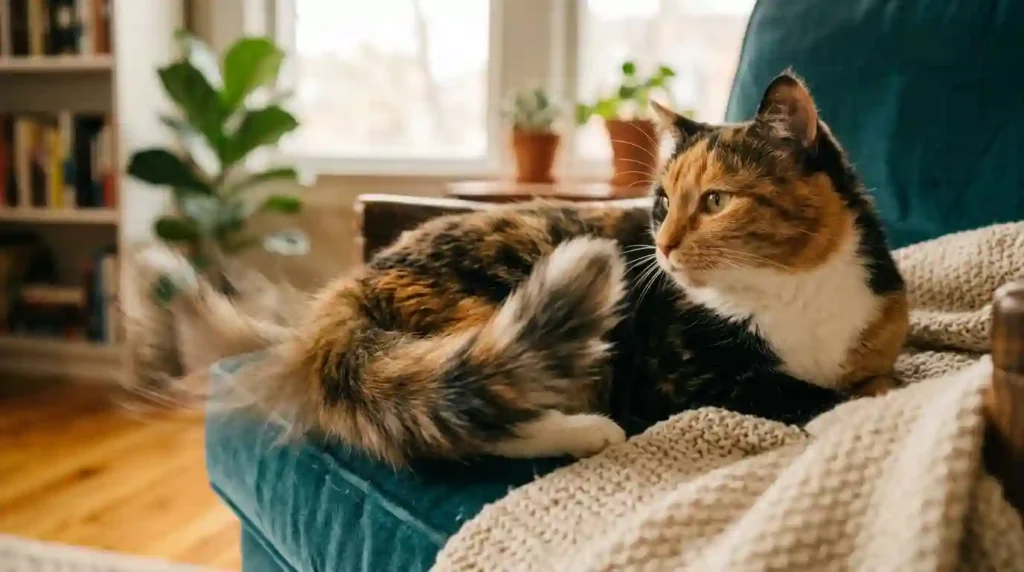
The question of What does it mean when cats wag their tail? does not have a single answer because cats use different tail movements to express different emotions. The meaning depends on the speed, direction, position of the tail, and the situation around the cat.
Many cat owners notice their pets moving their tails in different ways and wonder what those movements actually mean. A slow swish, quick flick, or gentle curl can communicate excitement, irritation, curiosity, or even affection.
Understanding feline body language helps owners build stronger relationships with their pets and respond appropriately to their needs.
Unlike dogs, where tail wagging often indicates happiness, cats may wag their tails when they are focused, annoyed, playful, or overstimulated. Learning these signals can prevent misunderstandings and help create a calmer environment for both cats and humans.
Why Cats Use Their Tails to Communicate
A cat’s tail is not just for balance. It is an important communication tool that helps express emotions and intentions.
Cats use their tails for several purposes:
- Communicating with humans and other animals
- Maintaining balance while jumping and climbing
- Showing confidence or fear
- Expressing interest or excitement
- Signaling when they need space
According to animal behavior researchers, cats rely heavily on body language because they have fewer vocal signals compared with humans. Their ears, eyes, whiskers, posture, and tail movements work together to communicate their emotional state.
A cat’s tail contains muscles, nerves, and vertebrae that allow highly controlled movements. This flexibility allows cats to create subtle signals that other cats—and attentive owners—can recognize.
Understanding Cat Tail Language
Cat communication is a combination of several body signals. Looking only at the tail may not always provide the complete picture.
For example:
- A moving tail combined with relaxed ears may indicate excitement.
- A moving tail with flattened ears may indicate stress or irritation.
- A raised tail with a relaxed body often suggests confidence.
Experts in veterinary behavior recommend observing the entire body rather than focusing on one movement alone.
Different Types of Cat Tail Movements and Their Meanings
Cats move their tails in many different ways. Each movement can provide clues about their emotional state.
| Tail Movement | Possible Meaning | Common Situation |
| Slow swishing from side to side | Focus, curiosity, mild excitement | Watching a toy or bird |
| Fast whipping motion | Irritation, overstimulation, frustration | During unwanted petting |
| Gentle tail twitching | Interest or concentration | Hunting or observing something |
| Tail wrapped around you | Affection and bonding | Greeting their owner |
| Puffing up the tail | Fear or feeling threatened | Encountering danger |
| Straight upright tail | Confidence and friendliness | Greeting familiar people |
Tail Curled Around the Body or People
When a cat wraps its tail around another cat, an object, or a person, it often shows social connection.
This behavior can be compared to a human gesture such as placing an arm around someone.
A cat wrapping its tail around your leg may be showing:
- Affection
- Trust
- Familiarity
Low or Tucked Tail
A lowered or tucked tail often indicates fear, uncertainty, or stress.
Cats may display this behavior when:
- Meeting unfamiliar animals
- Visiting a veterinarian
- Experiencing loud noises
- Entering a new environment
A frightened cat may also crouch, flatten its ears, and avoid eye contact.
Why Cats Are Different From Dogs
One of the biggest misunderstandings about pet behavior comes from comparing cats and dogs.
Dogs often wag their tails as a social greeting, excitement, or happiness signal. Cats, however, use tail movement in a more complex way.
A cat’s tail wag may indicate:
- Curiosity
- Emotional stimulation
- Frustration
- Hunting behavior
- Communication
This difference explains why interpreting cat behavior requires understanding feline-specific signals rather than applying dog behavior rules.
Scientific Understanding of Cat Communication
Research into feline behavior shows that cats communicate through a combination of vocal sounds, facial expressions, scent marking, and body movements.
A study published in the journal Applied Animal Behaviour Science examined feline-human interactions and found that cats use subtle behavioral signals to communicate their emotional states and social intentions.
Veterinary behavior specialists also emphasize that body language is one of the most reliable ways to understand a cat’s comfort level.
Modern research into animal cognition continues to show that domestic cats are socially aware animals capable of forming strong relationships with humans.
Love to Read More 210+ Fun Things to Do When You’re Bored: Exciting Activities for Every Situation
Frequently Asked Questions About Cat Tail Wagging
What does it mean when cats wag their tail?
A cat wagging its tail can mean different things depending on the situation, speed, and position of the tail. Unlike dogs, cats do not usually wag their tails only because they are happy.
A moving cat tail may indicate:
- Curiosity
- Excitement
- Concentration
- Irritation
- Stress
- Playfulness
To understand the exact meaning, owners should also observe other signals such as ear position, eyes, posture, and vocal sounds.
Do cats wag their tails when they are happy?
Yes, cats can move their tails when they are happy, but the movement is usually different from a dog’s happy tail wag.
A relaxed cat may:
- Hold its tail upright
- Gently move the tip
- Wrap its tail around a person
- Slowly curl its tail while interacting
A cat that is comfortable often has relaxed body language, soft eyes, and forward-facing ears along with gentle tail movements.
What does it mean when cats wag their tail while lying down?
A cat wagging its tail while lying down is often showing focus, mild excitement, or awareness of something nearby.
Common reasons include:
- Watching a bird outside the window
- Listening to a noise
- Preparing to play
- Responding to touch
If the tail begins hitting the floor strongly or moving rapidly, it may indicate annoyance or overstimulation.
Why do cats wag their tails when you pet them?
Cats may wag their tails during petting because they are experiencing strong emotions. The movement does not always mean they dislike the attention.
A slow or gentle tail movement may mean:
- Enjoyment
- Relaxation
- Excitement
However, a fast tail flick combined with tense muscles may mean the cat has had enough.
Many cats have a limit for physical interaction, and their tail often provides an early warning before they become uncomfortable.
Is a wagging cat tail a sign of anger?
Sometimes. A fast, forceful tail movement can indicate frustration, irritation, or stress.
Signs that a cat may be unhappy include:
- Rapid tail whipping
- Flattened ears
- Dilated pupils
- Growling or hissing
- Avoiding contact
A wagging tail alone does not always mean anger, so it is important to look at the complete body language.
Why does my cat flick the tip of its tail?
A flicking tail tip usually shows concentration or curiosity.
Cats commonly flick their tail tips when:
- Watching prey
- Looking at a toy
- Exploring something interesting
- Feeling alert
For example, a cat waiting to jump on a toy mouse may keep its body still while only moving the end of its tail.
What does it mean when a cat wraps its tail around you?
When a cat wraps its tail around your leg, arm, or another animal, it is often a friendly social behavior.
This may show:
- Trust
- Affection
- Familiarity
- Social bonding
Cats use their tails as part of their communication system, and this gesture is similar to a friendly greeting.
Why does my cat’s tail puff up?
A puffed-up tail usually means the cat feels frightened, threatened, or surprised.
The cat makes its tail appear larger by raising the hair, which is a natural defensive reaction designed to make it look bigger.
Common causes include:
- Sudden loud noises
- Unknown animals
- New environments
- Unexpected movements
A puffed tail is often accompanied by an arched back and defensive posture.
Do cats control their tail movements?
Yes, cats have strong control over their tails. Their tails contain muscles and nerves that allow precise movements.
Cats use this control for:
- Balance while jumping
- Communication
- Emotional expression
- Coordination during movement
The tail acts as both a physical tool and a communication signal.
Can a cat’s tail tell you its mood?
A cat’s tail can provide important clues about its mood, but it should not be interpreted alone.
For accurate understanding, observe:
| Body Signal | Possible Meaning |
| Upright tail | Confidence or friendliness |
| Slow tail movement | Focus or curiosity |
| Fast tail flicking | Irritation or overstimulation |
| Puffing tail | Fear or threat response |
| Tail wrapped around you | Affection |
Combining tail signals with ears, eyes, and body posture gives a much clearer picture of how a cat feels.
What does it mean when cats wag their tail? while hunting.
Tail movement during hunting is connected to a cat’s natural predatory behavior.
When a cat watches prey, its tail may twitch because it is highly focused and preparing for action.
This behavior can happen during:
- Hunting insects
- Playing with toys
- Watching birds
- Practicing stalking movements
Even indoor cats maintain many hunting instincts inherited from their wild ancestors.
Do kittens wag their tails differently from adult cats?
Yes. Kittens often display more exaggerated movements because they are learning communication skills and exploring their environment.
A kitten may move its tail while:
- Playing
- Practicing hunting
- Interacting with siblings
- Discovering new objects
As cats mature, their tail movements usually become more controlled and easier to interpret.
Conclusion:
The meaning behind tail movement depends on several factors, including speed, position, the surrounding situation, and other body signals. A slow tail swish may show curiosity, while a rapid tail flick can indicate irritation or overstimulation.
For cat owners searching for What does it mean when cats wag their tail? the most important lesson is that there is no single meaning behind every tail movement. Cats are complex animals, and their body language must be understood as a complete picture.
By learning to recognize tail positions, ear movements, facial expressions, and behavior patterns, owners can respond better to their cats’ needs and build a stronger bond.