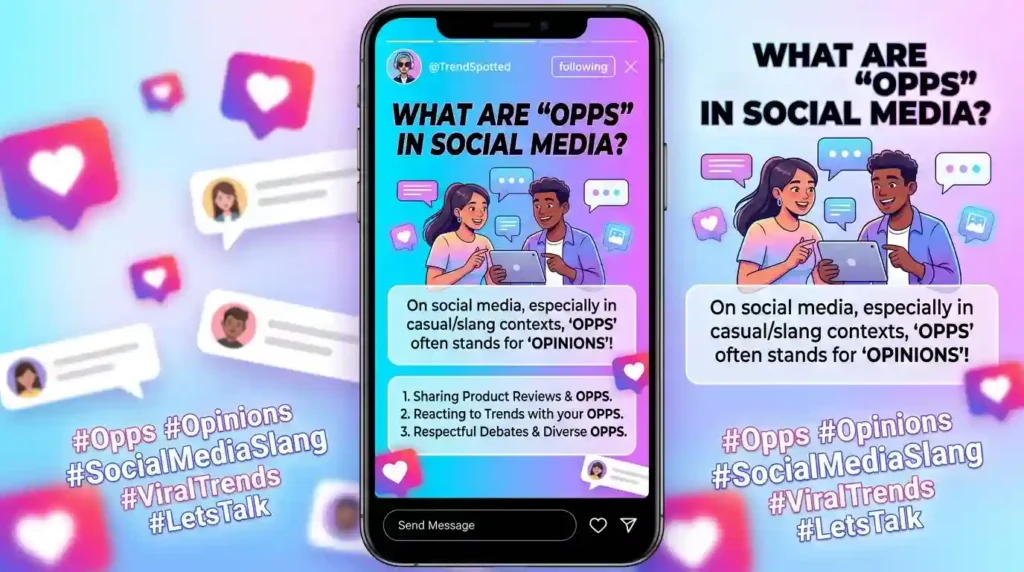
This guide explains the opps meaning in social media. and shows how people use this slang term today. You’ll learn where the word started, how its meaning changes in different situations, and why the same three letters can sound funny in one post but serious in another.
You can find “opps” in many comment sections, TikTok captions, and group chats. People often use it when they joke about seeing an “opp” at the grocery store or when they tell friends to stay alert around their “opps.” If you don’t know what this slang word means, you’re not the only one. This guide will help you understand its meaning, usage, and context.
What Is the Opps Meaning in Social Media?
At its core, “opps” is short for “opposition” or “opponents.” <cite index=”9-1″>Merriam-Webster notes that opps originated in hip-hop lyrics, where it was initially used to describe people with whom one is in potentially mortal combat, but the term has since broadened to general use and may now refer to a wide range of antagonists</cite>.
- A genuine rival or enemy, tied to real conflict
- A friend who did something mildly annoying, used jokingly
- A general “hater” or someone perceived as working against you
- A rival team, coworker, or classmate in a lighthearted competitive sense
<cite index=”9-1″>Merriam-Webster’s own usage examples show this range, from a Reddit comment describing a house party “directed by opps” to an Instagram caption joking about stealing a rival’s shopping cart</cite> — proof that the word swings between real tension and pure comedy depending on the post.
Where Does “Opps” Come From?
Drill Music and Chicago Street Culture
To understand the opps meaning in social media today, it helps to know its roots. <cite index=”10-1″>In contemporary rap and hip-hop, “opp” or “opps” almost exclusively refers to opposition or enemies, a usage that became particularly prevalent in drill rap, a subgenre that emerged from Chicago in the early 2010s before spreading to other cities</cite>. Drill artists used the term to reference rivals, territorial conflict, and street tension in their lyrics, and phrases like “sliding on the opps” and “checking for opps” became genre staples.
From there, the word moved outward — first through other hip-hop scenes, then through Twitter and Instagram, and eventually into the mainstream vocabulary of teenagers who have never listened to a single drill track.
Not to Be Confused With “O.P.P.”
Here’s where a lot of confusion happens, especially for anyone over 35. <cite index=”10-1″>In the early 1990s, the acronym O.P.P. gained mainstream popularity through Naughty by Nature’s hit song, where it stood for “Other People’s Property” — referring to being involved with someone else’s romantic partner</cite>. That’s a completely different meaning from today’s slang.
Modern “opps” — referring to enemies or rivals — is unrelated to that 1990s acronym. If you hear an older relative reference “O.P.P.” and assume they mean the same thing your teenager posts about online, that mix-up explains a lot of confused family group chats.
Opp vs. Opps: Singular and Plural
The words are simple once you separate them:
| Term | Meaning |
| Opp | A single rival, enemy, or adversary |
| Opps | Multiple rivals, enemies, or adversaries (also used as a general, collective term) |
| Opp energy | Behavior that feels disloyal, shady, or like someone is working against you |
| Opp pack | A harsher, more disrespectful reference to a defeated or deceased rival |
How the Opps Meaning in Social Media Differs by Platform
Context and platform matter enormously here. The opps means in social media isn’t identical everywhere it shows up.
TikTok and Instagram
On these platforms, “opps” usually leans playful. Trends built around catching your “opp” in public, reacting dramatically to seeing a rival, or joking about petty grievances have turned the word into comedy fuel. A caption like “caught my opp at the grocery store” is almost never about real danger — it’s a punchline.
Twitter/X and Threads
Usage here sits somewhere in the middle. It can be used to playfully roast someone, but it’s also common in genuinely heated exchanges, sports rivalries, or callout posts where someone is being described as a real antagonist.
Group Chats and DMs
Between friends, “opp” is often affectionate sarcasm. Calling a friend “the opp” for stealing your fries or beating you at a game is a joke, not an accusation.
Drill Music Communities and Related Threads
This is where the term keeps more of its original weight. In posts and comment threads tied to drill music, gang-adjacent content, or real-world rivalries, “opps” retains a more serious, sometimes dangerous connotation rather than a lighthearted one.
A Quick Real-World Comparison
| Context | Example Post | Likely Tone |
| TikTok comedy skit | “POV: you see your opp at Target” | Playful, exaggerated |
| Friend group chat | “You ate my last slice, you’re my opp now” | Joking, affectionate |
| Sports fan account | “Our opps just lost again lol” | Competitive, casual |
| Drill-adjacent post | “Watching out for opps tonight” | Serious, potentially real conflict |
| Older relative’s comment | “What’s an O.P.P.?” | Genuine confusion, different era |
Why Understanding Slang Like This Matters
Slang isn’t just internet noise — it reflects how language spreads through culture in real time. Researchers who study linguistics have long noted that terms born in specific communities, particularly African American Vernacular English and hip-hop culture, frequently move into mainstream youth slang within a few years of gaining traction in music. “Opps” follows that same well-documented pattern: a term with roots in a specific regional music scene that spread nationally, then globally, largely through social media amplification.
For parents, educators, brand managers, and anyone managing an online community, recognizing the opps meaning in social media has practical value. Misreading a joking comment as a genuine threat — or missing a real warning sign because you assumed it was a joke — both carry real consequences. Context, platform, and relationship between the people involved are the three biggest clues for telling the difference.
Opps vs. Similar Slang Terms
“Opps” often gets grouped with other words describing rivalry or dislike, but they aren’t interchangeable:
- Hater — Someone who criticizes or dislikes you, often from a distance, without direct conflict.
- Rival — A more neutral, competitive term, often used in sports or professional contexts.
- Enemy — A stronger, more formal word implying real hostility.
- Opp — Sits between “hater” and “enemy,” carrying more cultural weight and street-culture origin than either.
The key distinction: a hater is background noise, while an opp is framed as someone actively working against you — even if, in most modern social media use, that’s said with a laughing emoji rather than any real animosity.
How to Use “Opps” Appropriately
If you’re thinking about using the term yourself, a few guidelines help:
- Read the tone of the space first. A joking meme page is different from a comment thread about a real conflict.
- Don’t use it in professional settings. It reads as slang, not appropriate for résumés, work emails, or formal communication.
- Understand its weight before joking with it. The word has real roots in serious rivalry and conflict; using it without any awareness of that can come across as trying too hard.
- Watch for context clues in others’ posts. Emojis, exclamation points, and surrounding language usually signal whether someone means it seriously or as a joke.
Frequently Asked Questions
What is the opps meaning in social media?
The opps means generally refers to rivals, enemies, or people perceived as being against you. It can be used seriously, especially in posts tied to real conflict, or jokingly, especially on TikTok and in friend group chats.
Is “opps” the same as “O.P.P.” from the 1990s song?
No. The 1990s acronym O.P.P., popularized by Naughty by Nature, stood for “Other People’s Property” and referred to romantic involvement with someone else’s partner. Today’s “opps” slang, meaning rivals or enemies, has separate roots in 2010s drill music.
Where did “opps” originate?
The term is widely traced to Chicago’s drill rap scene in the early 2010s, where it was used to reference rivals and street conflict. It later spread broadly through hip-hop and then into mainstream social media slang.
Is calling someone an “opp” always serious?
Not anymore. While the term still carries real weight in some communities and contexts, especially those tied to drill music culture, it’s frequently used jokingly on platforms like TikTok and in casual friend group chats.
What’s the difference between “opp” and “hater”?
An opp is generally framed as an active rival or adversary, while a hater simply criticizes or dislikes someone, often without direct involvement or conflict.
Is it okay to use “opps” in a work or professional setting?
No. It’s casual internet and youth slang, and using it in professional communication would come across as out of place.
What does “opp energy” mean?
“Opp energy” describes behavior that feels disloyal, shady, or like someone is secretly working against you, even if they’re supposed to be on your side.
Love to read More 160+ Things to Do When You’re Bored With Friends: Fun & Engaging Ideas
Conclusion
The opps meaning in social media has traveled a long way — from Chicago drill music describing genuine rivalry to a word teenagers use to joke about who ate the last slice of pizza. That range is exactly what makes it worth understanding: the same word can be a punchline or a real signal, and telling the difference comes down to reading the platform, the tone, and the relationship between the people using it. Once you know its roots and its modern range of use, decoding “opps” the next time it shows up in your feed becomes a lot easier.