
That’s the short version of canopy tour vs zipline what is the difference? But the full picture involves more than just length. Let’s break down each activity on its own before comparing them side by side.
If you’ve ever browsed adventure activities while planning a trip to Costa Rica, Hawaii, or a mountain destination closer to home, you’ve probably seen “zipline” and “canopy tour” listed as separate options — sometimes right next to each other, sometimes used as if they mean the same thing. so you can pick the right experience based on how much time you have, how much thrill you want, and what kind of scenery matters most to you.
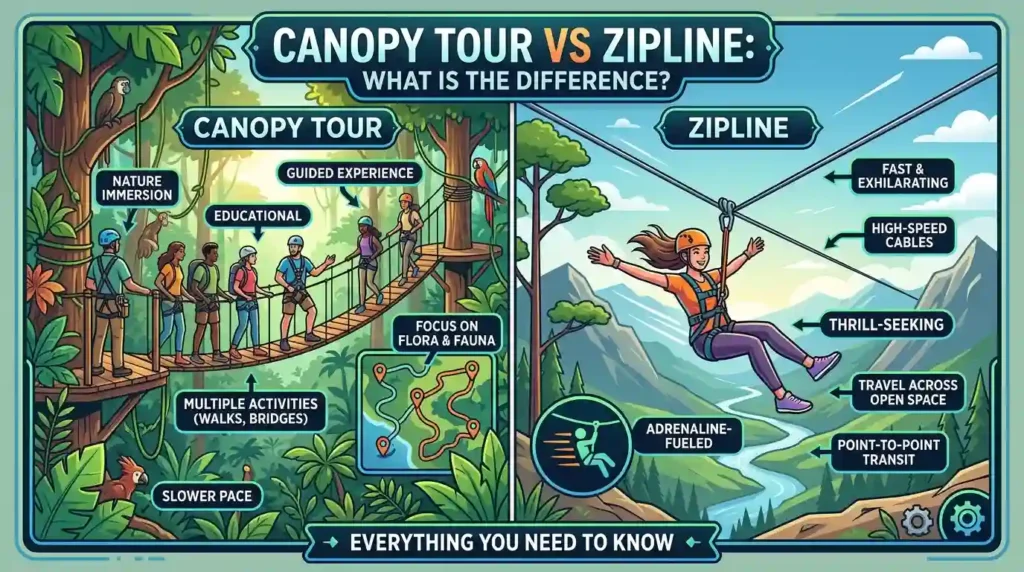
A zipline is a single ride along one cable from one point to another, while a canopy tour is a longer, multi-stage adventure that strings several ziplines together with platforms, bridges, and sometimes short hikes through a forest.
What Is a Zipline?
A zipline is a suspended cable stretched between two points at different elevations. Riders wear a harness connected to a pulley system and use gravity to glide from the higher point to the lower one.
Key characteristics of a standalone zipline:
- Point A to point B. It’s a direct, single ride rather than a multi-stop course.
- Speed-focused. Ziplines are built for a fast, adrenaline-driven experience.
- Shorter duration. A single zipline ride typically lasts anywhere from a few seconds to a couple of minutes, depending on cable length.
What Is a Canopy Tour?
A canopy tour is a structured, guided adventure that takes participants through a forest canopy using a series of ziplines connected by platforms, suspension bridges, and sometimes spiral staircases or short walking trails.
Key characteristics of a canopy tour:
- Multiple stages. Canopy tours typically include anywhere from 6 to 12+ separate ziplines on a single course.
- Built around the forest itself. Tour operators construct platforms in or among trees, allowing participants to stay elevated for most or all of the tour.
- Measured in time Rather than measuring canopy tours by distance, tour operators usually describe them by how long the full course takes — commonly between 2 and 5.5 hours.
- Guided experience. Canopy tours almost always include trained guides who explain the ecosystem, wildlife, and safety procedures along the way.
The concept actually originated with scientists. Biologists and ecologists in the 1970s built simple line systems above the forest floor so they could study the treetop ecosystem — known as the canopy — without disturbing it. Adventure tourism operators later adapted that same idea into the recreational canopy tours available today.
Canopy tour vs zipline what is the difference: Side-by-Side Comparison
The table below lays out canopy tour vs zipline, what is the difference at a glance, covering the factors that matter most when choosing between them.
| Feature | Zipline | Canopy Tour |
| Structure | Single cable ride | Multiple ziplines + platforms + bridges |
| Typical duration | Seconds to a few minutes | 2 to 5.5 hours |
| Measured by | Distance (length of cable) | Time (length of full tour) |
| Focus | Speed and adrenaline | Immersive nature exploration |
| Guide involvement | Minimal to moderate | Extensive, often naturalist-led |
| Physical demand | Low | Low to moderate (stairs, walking between platforms) |
| Best for | Quick thrill, first-timers | Longer excursions, eco-tourism, groups |
Why People Use the Terms Interchangeably
If you’ve noticed that many adventure companies advertise “zipline tour” and “canopy tour” as if they’re the same thing, you’re not imagining it. In destinations like Costa Rica, Puerto Vallarta, and parts of Hawaii, most commercial zipline operations are technically canopy tours — they include multiple lines, platforms, and guided elements, even when marketed under the simpler “zipline” name.
This overlap happens because:
- Search habits favor “zipline.” More travelers search for “zipline” than “canopy tour,” so operators often use the more familiar term even when describing a full canopy-style course.
- Almost every zipline tour includes canopy elements. A standalone, single-cable zipline with no platforms or guided structure is relatively rare in commercial tourism; most operators build multi-line courses by default.
- Marketing simplicity. It’s easier to advertise “zipline adventure” than to explain the distinction between a single ride and a multi-platform course.
So when you’re comparing canopy tour vs zipline what is the difference really comes down to reading the tour description carefully rather than relying on the name alone.
Which One Should You Choose?
Choose a Standalone Zipline If You Want:
- A short, high-speed thrill
- A quick activity that fits into a packed travel itinerary
- Minimal time commitment (often under 30 minutes total, including setup)
- A simple introduction to the sport before committing to a longer course
Choose a Canopy Tour If You Want:
- A longer, more immersive outdoor experience
- Multiple ziplines combined with bridges, platforms, and scenery
- A guided nature or ecosystem experience, not just speed
- A memorable group activity for families, birthdays, or team-building events
Real-World Examples
To better understand the difference in a canopy tour vs zipline experience, let’s look at how these two adventures compare at real-world adventure sites:
- One Wisconsin-based operator runs a canopy tour that takes approximately 2.5 hours to complete and includes 8 ziplines, 5 sky bridges, and 3 spiral staircases built through a wooded course.
- A zipline operator in Hawaii offers a course built around 8 connected lines, including a half-mile-long line over open water — technically a canopy-style tour, even though it’s marketed simply as a“zipline tour.”
- Adventure parks built for large-scale events, such as scouting jamborees, have offered both formats side by side: standalone ziplines measured by length (some exceeding 3,500 feet) and separate canopy tour courses measured by total time (ranging from 2 to 3.5 hours).
Still weighing canopy tour vs zipline what is the difference, what is the difference for your specific trip? Match your priorities to the lists below before booking.
Physical Requirements and Accessibility
Neither activity typically requires advanced fitness. Most operators set the bar low on purpose, since these tours are designed for a wide range of ages and body types.
- Ziplines: Usually require the ability to sit in a harness and use your arm to apply light braking pressure. Minimum weight requirements typically start around 70 pounds.
- Canopy tours: Add a bit more physical activity, since you’ll climb stairs, cross bridges, and move between platforms throughout the course. Still, most tours are built so that anyone who can walk up a flight of stairs comfortably can complete the course.
Because of these low barriers to entry, both activities are popular with families, older adults, and first-time adventure travelers — some canopy tour operators report participants well into their 90s completing a full course.
Safety Standards
Both ziplines and canopy tours rely on similar core safety systems:
- A full-body or seated harness attached to a steel cable or pulley system
- Continuous attachment throughout the course, meaning participants stay clipped in at all times
- Trained guides who handle equipment checks, braking instructions, and platform transitions
- Weight and age restrictions set by each operator
Reputable operators typically follow guidelines set by organizations like the Adventure Travel Trade Association and the International Association of Amusement Parks and Attractions, though specific certification requirements vary by country and region.
Cost and Booking Considerations
Understanding canopy tour vs zipline, what is the difference also matters when you’re comparing prices across operators, since the two experiences aren’t always priced the same way.
- Standalone ziplines are often priced per ride or as part of a small bundle, making them a lower-cost add-on to a broader itinerary.
- Canopy tours are usually priced as a full package, since the cost covers guides, multiple stations, safety equipment checks, and sometimes transportation to and from the course.
- Combination packages are common in destinations like Costa Rica and Mexico, where operators bundle a canopy tour with other activities such as hiking, cave exploration, or wildlife viewing.
Before booking, it’s worth asking the operator directly how many lines are included, how long the course takes, and whether the tour includes bridges or platforms. That single question usually clears up any confusion faster than the marketing name alone.
Frequently Asked Questions
Canopy tour vs zipline what is the difference in simple terms? A zipline is one ride along a single cable. A canopy tour is a longer course made up of several ziplines connected by platforms, bridges, and sometimes short hikes through a forest.
Is a canopy tour more expensive than a zipline? Generally, yes. Because canopy tours last longer and include more infrastructure — multiple lines, bridges, and guided instruction — they tend to cost more than a single standalone zipline ride.
Which is more thrilling, a zipline or a canopy tour? A standalone zipline typically delivers a faster, more intense burst of speed in a short time. A canopy tour spreads the thrill across a longer experience, combining speed with scenery and exploration.
Do I need to be in good shape for a canopy tour? Not usually. Most canopy tours are designed for a wide range of fitness levels, though they involve more walking and stair-climbing than a single zipline ride.
Are canopy tours safe for kids and older adults? Yes, in most cases. Weight and age minimums vary by operator, but canopy tours are commonly marketed as family-friendly, with many welcoming children as young as 6 to 8 years old and active seniors as well.
Why do some companies call a canopy tour a “zipline tour”? Because “zipline” is the more commonly searched and recognized term, many operators use it as a catch-all label even when the experience technically includes canopy tour elements like platforms and bridges.
How long does a typical canopy tour take? Most canopy tours run between 2 and 3.5 hours, though some extended courses can take up to 5.5 hours to complete.
Love To Read More Meaning of ratchetness Explained: From Internet Slang to Mainstream Conversations
Conclusion
So, canopy tour vs zipline what is the difference? At its core, a zipline is a single, fast ride between two points, while a canopy tour is a longer, guided adventure built from multiple ziplines, platforms, and bridges through the forest canopy. In practice, the two terms overlap constantly in marketing, so the best approach is to check the specifics of any tour — the number of lines, total duration, and included features — before you book.
If you’re short on time and want a quick adrenaline rush, a standalone zipline delivers exactly that. If you want a longer, more immersive experience with scenery, wildlife, and a guided journey through the treetops, a canopy tour is the better fit. Either way, you’ll come away with a new perspective — literally — on the landscape below.