
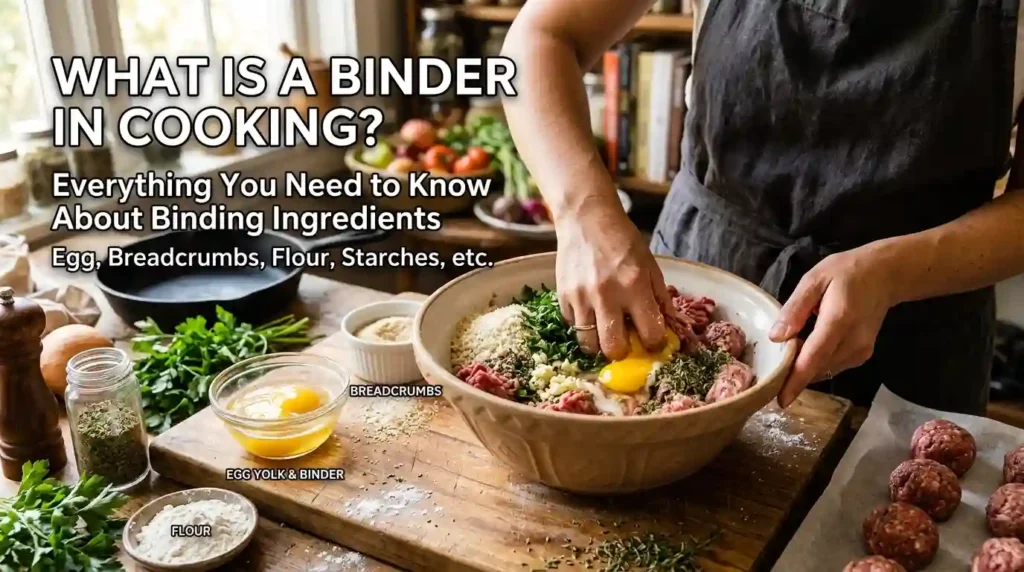
This guide answers what is a binder in cooking in full detail — the science behind how binders work, the most common types, exact ratios for real recipes, and how to substitute them when you’re avoiding eggs, gluten, or animal products.
If you’ve ever pulled a meatloaf out of the oven only to watch it crumble apart the moment you cut into it, you’ve experienced firsthand what happens when a binder is missing or used incorrectly. That same crumbling problem shows up in veggie burgers, gluten-free bread, meatballs, and even certain sauces.
What Is a Binder in Cooking? (Quick Definition)
A binder is any ingredient added to a recipe to hold other ingredients together, preventing a mixture from crumbling, falling apart, or separating during and after cooking. Common examples include eggs, flour, breadcrumbs, starches, and gelatin.
So when someone asks what is a binder in cooking, the short answer is: it’s the ingredient responsible for structure. Without one, mixtures like ground meat, vegetable purées, or gluten-free batters often lack the cohesion needed to hold their shape once heat is applied.
Binders show up across nearly every category of cooking:
- Meat dishes: meatballs, meatloaf, burgers, sausages
- Baked goods: cakes, cookies, bread, gluten-free baking
- Vegetarian and vegan dishes: veggie burgers, bean-based patties
- Desserts: jellies, panna cotta, aspics
- Sauces: gravies, roux-based sauces, glazes
Binder vs. Thickener: What’s the Difference?
Before going further, it helps to clarify a common point of confusion. A binder and a thickener aren’t always the same thing, even though some ingredients can do both jobs.
| Term | Primary Function | Example Ingredients |
| Binder | Holds solid ingredients together, preventing separation | Eggs, breadcrumbs, gelatin |
| Thickener | Increases the viscosity of a liquid | Cornstarch slurry, roux |
| Both | Can bind and thicken depending on use | Flour, starches |
Eggs and breadcrumbs primarily function as binders — they hold solid pieces together. Cornstarch and flour, on the other hand, often function as thickeners in sauces but can also act as binders in meatballs or veggie patties. The distinction comes down to how the ingredient is being used, not just what it is.
The Science Behind How Binders Work
Understanding what is a binder in cooking at a deeper level is means understanding the chemistry happening in your mixing bowl. Most binders work through one of three basic mechanisms:
1. Protein Coagulation
When proteins — like those in eggs, milk, or gelatin — are heated, they unfold and link together into a network. Think of it as thousands of tiny protein strands grabbing onto each other, forming a web that traps other ingredients inside it. This is exactly what happens when an egg goes from liquid to solid as it cooks.
2. Starch Gelatinization
Starches, found in flour, cornstarch, potato starch, and tapioca starch, are long chains of sugar molecules called polysaccharides. When starch granules are heated in the presence of liquid, they absorb water, swell, and form a gel-like structure that binds surrounding ingredients together. This is why starches need to be cooked — raw starch doesn’t have the same binding power.
3. Water Absorption and Swelling
Some binders, like ground flaxseed, chia seeds, and psyllium husk, work simply by absorbing large amounts of water and swelling into a gel. Ground flaxseed, for example, can trap up to 30 times its weight in water, according to research cited by the National Library of Medicine. That swelling creates the sticky, cohesive texture needed to hold a mixture together.
Common Binders in Cooking (and How They Work)
Eggs
Eggs are the most widely used binder in both baking and savory cooking. The proteins in egg whites coagulate when heated, creating a firm, flexible structure, while the yolk’s natural emulsifiers (like lecithin) help bind water-based and fat-based ingredients together.
- Typical ratio: One egg per pound of ground meat is a standard starting point for meatballs, burgers, and meatloaf.
- Pro tip: Room-temperature eggs bind more evenly than cold eggs straight from the refrigerator.
Flour
All-purpose flour is a classic dry binder. It needs to be cooked to bind safely and effectively, since raw flour doesn’t gelatinize. Flour adds a bit of chew and assists with browning, which makes it especially useful in meatballs and pan-fried dishes.
- Common use: A small amount of flour in cookie dough helps control spreading; in meat mixtures, it absorbs excess moisture so patties don’t steam themselves into a mushy texture.
- Caution: Too much flour makes baked goods and meat mixtures dense, so it’s best to start with a small amount and adjust gradually.
Breadcrumbs
Breadcrumbs — whether regular, panko, or homemade — absorb moisture from a mixture and swell into a soft paste that fills gaps between meat particles or vegetable pieces. This creates tenderness and prevents the finished dish from becoming tough.
- Standard guideline: About ½ to ¾ cup of breadcrumbs per pound of ground meat is a common starting ratio for meatballs and meatloaf.
Starches (Cornstarch, Potato Starch, Tapioca Starch)
Starch-based binders create a cleaner, glossier finish compared to flour and are especially popular in Asian-inspired dishes for their lighter texture. Because starches absorb water aggressively, less is typically needed compared to breadcrumbs.
- Typical ratio: One to two tablespoons of starch per pound of ground meat, since starches bind more efficiently than breadcrumbs by volume.
Binder Ratios for Common Recipes
Getting the ratio right matters as much as choosing the right binder. Too little, and your dish falls apart. Too much, and you end up with something dense, pasty, or bready that overwhelms the other flavors.
| Dish | Recommended Binder Ratio |
| Meatballs / Meatloaf | 1 egg + ½–¾ cup breadcrumbs per pound of meat |
| Meatballs (starch-based) | 1–2 tablespoons cornstarch or tapioca starch per pound of meat |
| Veggie burgers | 1 egg (or flax egg) + ¼–½ cup oats or breadcrumbs per 2 cups of vegetable mixture |
| Gluten-free bread | ½–1 teaspoon xanthan gum per cup of gluten-free flour |
| Sauces and gravies (thickening) | 1–2 tablespoons flour or cornstarch per cup of liquid |
Fattier meats generally need less binder overall, since the fat itself acts as a natural lubricant and contributes to cohesion as it renders during cooking.
Gluten-Free and Vegan Binder Alternatives
Traditional binders like eggs, wheat flour, and breadcrumbs aren’t always an option. Fortunately, there are well-tested alternatives that work just as effectively once you understand the ratios.
Flax Egg
Combine 1 tablespoon of ground flaxseed with 3 tablespoons of water and let it sit for about 15 minutes until it becomes gelatinous. This mixture replaces one egg in most recipes and adds fiber and omega-3 fatty acids as a bonus.
Chia Egg
Similar to a flax egg, 1 tablespoon of chia seeds mixed with 3 tablespoons of water creates a gel-like substitute for one egg, particularly useful in baking.
Psyllium Husk
One teaspoon of psyllium powder mixed with 3 tablespoons of water can replace one egg. Psyllium is especially effective in gluten-free bread, where it mimics some of the elasticity that gluten would normally provide.
Pureed Vegetables and Beans
Mashed potatoes, sweet potatoes, and pureed beans like black beans or chickpeas add moisture, bulk, and binding power, particularly in veggie burgers and vegetable-based patties. Keep in mind that mashed potatoes will impart their own distinct flavor to the dish.
Silken Tofu and Applesauce
Both work well as egg substitutes in vegan baking. Silken tofu creates a creamy texture suited to cakes and muffins, while applesauce adds moisture and a hint of natural sweetness.
Love To Read More http://200+ Productive Things to Do When Bored: Practical & Rewarding Ideas
Gluten-Free Binder Comparison
| Binder | Best Use | Ratio |
| Flax egg | Baking, veggie burgers | 1 tbsp flaxseed + 3 tbsp water = 1 egg |
| Chia egg | Baking | 1 tbsp chia seeds + 3 tbsp water = 1 egg |
| Psyllium husk | Gluten-free bread | 1 tsp powder + 3 tbsp water = 1 egg |
| Xanthan gum | Gluten-free baking | ½–1 tsp per cup of flour |
| Guar gum | Gluten-free bread | Up to 1 tsp per cup of flour |
Pulse flours — made from lentils, chickpeas, or black-eyed beans — are also worth mentioning. Research on low-fat meatball formulations found that pulse flours matched or outperformed traditional dried bread (rusk) for water-holding capacity, likely because their combination of protein and fiber adds binding strength beyond what starch alone provides.
How Binders Are Regulated in Commercial Food
Binders aren’t just a home-cooking concern — they’re regulated in commercial meat products as well. In the United States, the USDA caps binders and extenders (such as cereals, dried milk, and soy flour) at 3.5% of total batch weight in raw sausages, with added water separately limited to 3%. These limits exist specifically to prevent manufacturers from diluting meat content while still labeling a product as sausage.
Products labeled simply as “ground beef,” by contrast, cannot contain any added binders or extenders at all. This regulatory distinction is part of why fast-food chains often advertise “all-beef patties” — it signals that no binding agents have been added to stretch the meat content.
Common Mistakes When Using Binders
Even experienced cooks run into trouble with binders. Here are the most frequent issues:
- Adding too much binder. This is the most common mistake, usually driven by a fear of the dish falling apart. The result is often dense, dry, or rubbery texture instead.
- Not letting dry binders hydrate. Throwing dry oats or breadcrumbs directly into a wet mixture without giving them time to absorb moisture can leave weird dry pockets throughout the finished dish.
- Skipping resting time. Some binders need a few minutes to fully activate before cooking begins. Skipping this step means the binder hasn’t done its job by the time heat is applied.
- Overmixing. Especially with meat mixtures, overworking the ingredients can make the final texture tough rather than tender.
- Ignoring flavor impact. Some binders, particularly strongly flavored flours or mashed vegetables, can clash with or overpower the other ingredients in a dish.
The safest approach is to start conservatively. You can always add a bit more binder if a mixture feels loose, but you can’t remove it once it’s already incorporated.
How to Choose the Right Binder for Your Dish
Choosing the right answer to what is a binder in cooking for your specific recipe comes down to a few practical questions:
- What texture are you going for? Starches give a lighter, glossier result; breadcrumbs and flour add more chew and heft.
- Are you avoiding allergens? Eggs, dairy, and gluten each have well-tested substitutes if needed.
- How will the dish be cooked? A long, slow bake can handle different binders than a quick pan-fry, since some binders need more time to fully set.
- Will the dish be served cold? Gelatin and similar protein-based binders are ideal for cold preparations like aspics and panna cotta, where heat-based coagulation won’t apply.
Real-World Example: Building a Meatball Recipe
To see how binders come together in practice, consider a standard meatball recipe. A typical approach combines ground meat with breadcrumbs, forms a well in the center, and adds eggs along with herbs, spices, and sometimes grated cheese. The eggs coagulate as the meatballs cook, while the breadcrumbs absorb excess moisture and swell to fill gaps in the meat’s protein structure. Together, these two binders reinforce each other — a good illustration of why so many classic recipes pair a protein-based binder with a starch-based one rather than relying on just one ingredient.
What Is a Binder in Cooking? A Brief History
Binders aren’t a modern culinary invention. As soon as humans began combining multiple ingredients into a single dish, they needed a way to keep those ingredients from separating during cooking or serving. Eggs, for instance, have been used for centuries in baking to bind ingredients and provide structural support to cakes and pastries.
Different cultures developed their own binding traditions based on locally available ingredients. Rice flour and tapioca starch became staples in Southeast Asian cooking, where they create the springy, bouncy texture found in dishes like fish balls and certain dumplings. In the Middle East and Mediterranean, bulgur and breadcrumbs have long served as binders in dishes like kibbeh. Latin American cooking often relies on masa (corn dough) as both a binder and a base ingredient in dishes like tamales. This regional variation illustrates a broader point: the question of what is a binder in cooking doesn’t have one universal answer — it depends heavily on the ingredients a given cuisine has historically had on hand.
The effectiveness of any binder is also shaped by factors beyond the ingredient itself, including moisture content, cooking temperature, and the presence of other ingredients in the mixture. A binder that works beautifully in a dry, low-moisture environment might behave completely differently in a wetter mixture, which is part of why recipe testing and small adjustments matter so much.
When You Don’t Need a Binder at All
Not every dish requires one. Salads, sautéed vegetables, and many one-pot meals hold together just fine without any added binding agent, since there’s no crumbly mixture that needs reinforcement in the first place. Understanding what is a binder in cooking also means recognizing when it’s unnecessary — adding a binder to a dish that doesn’t need one can dilute flavor and add unwanted density for no real benefit. The general rule: if a mixture needs to hold its shape after cooking — think patties, loaves, or gluten-free baked goods — a binder is probably worth using. If the dish is naturally cohesive, such as a stir-fry or a composed salad, you can safely skip it.
Frequently Asked Questions
What is a binder in cooking? A binder is any ingredient used to hold other ingredients together in a dish, preventing crumbling or separation. Common examples include eggs, breadcrumbs, flour, starches, and gelatin.
What’s the difference between a binder and a thickener? A binder holds solid ingredients together, while a thickener increases the viscosity of a liquid. Some ingredients, like flour and starches, can perform both functions depending on how they’re used.
How much binder should I use in meatballs or meatloaf? A common starting ratio is one egg plus ½ to ¾ cup of breadcrumbs per pound of ground meat. If using a starch instead of breadcrumbs, one to two tablespoons per pound is typical.
Can mashed potatoes work as a binder? Yes. Mashed potatoes provide moisture, starch, and a creamy texture, making them effective in dishes like potato cakes and veggie burgers. Keep in mind they’ll add a noticeable potato flavor.
What’s a good egg substitute for binding? Flax eggs, chia eggs, silken tofu, and applesauce are all effective vegan alternatives. A flax egg (1 tablespoon ground flaxseed plus 3 tablespoons water) is one of the most versatile options.
Conclusion
So, what is a binder in cooking? An ingredient used to hold other ingredients together, keeping mixtures—like meatballs, crab cakes, or veggie burgers—from falling apart.
At its core, it’s any ingredient that holds a mixture together through protein coagulation, starch gelatinization, or simple water absorption — think eggs, breadcrumbs, flour, starches, and gelatin. Choosing the right one and using it in the right ratio is often the difference between a meatloaf that holds its shape and one that crumbles the moment you slice it.
Whether you’re working with a classic combination like egg and breadcrumbs, a starch-based option for a lighter texture, or a plant-based substitute for a vegan or gluten-free dish, understanding how binders work gives you far more control in the kitchen. Once you know the mechanics, choosing and adjusting binders becomes second nature — and your dishes will hold together exactly the way you intended.
Read More http://160+ Things to Do When You’re Bored With Friends: Fun & Engaging Ideas