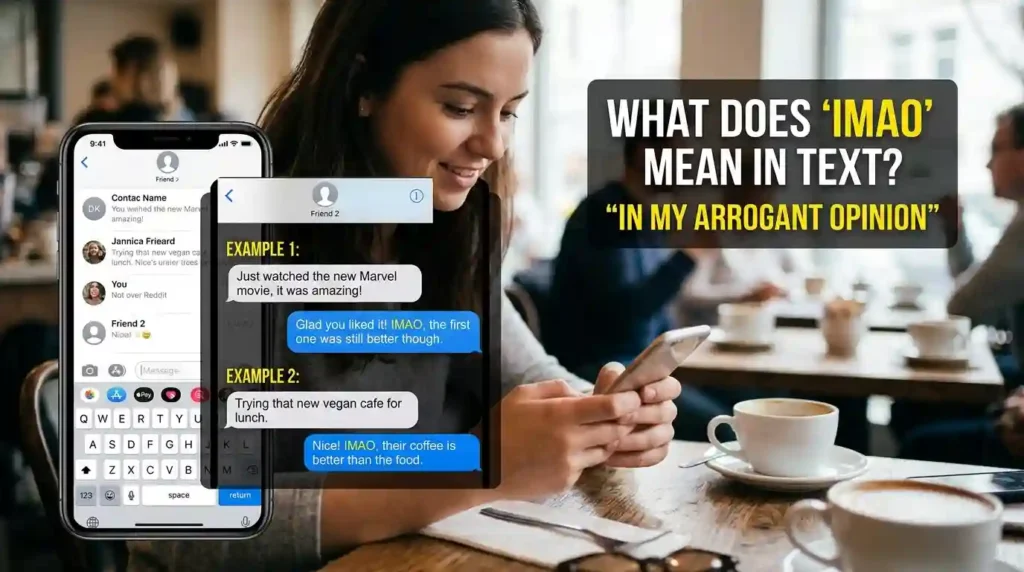
Learning What Does IMAO Mean in Text is useful for anyone who wants to follow modern digital conversations more easily. Whether you are reading a comment, receiving a message from a friend, or exploring internet culture, knowing common abbreviations can help you understand the intended tone behind a conversation.
In this guide, we will explain the meaning of IMAO, where it came from, how people use it in different situations, and provide real examples to show how this abbreviation appears in everyday texting. You will also learn the difference between IMAO and other similar slang terms to avoid confusion while communicating online.
What Is IMAO?
IMAO is an internet slang abbreviation most commonly understood as:
“In My Arrogant Opinion”
It is a playful or exaggerated version of more familiar expressions like “IMO” (In My Opinion) or “IMHO” (In My Humble Opinion).
People use IMAO when they want to express an opinion in a humorous, sarcastic, or slightly overconfident tone.
For example:
IMAO, that movie should’ve won every award.
Here, the speaker is clearly expressing a strong opinion, but in a joking way.
However, slang is flexible, and not everyone uses it strictly the same way. In some online spaces, it is also interpreted as a typo or variation of LMAO (Laughing My A** Off), especially when context suggests humor.
That’s why understanding What Does IMAO Mean in Text requires paying attention to tone, platform, and surrounding messages.
In most modern usage, IMAO is:
- Opinion-based
- Informal
- Slightly sarcastic or exaggerated
- Used in jokes or commentary
Unlike formal abbreviations, it doesn’t follow strict linguistic rules. Instead, it evolves through online usage patterns.
How IMAO Is Used in Texting
In texting conversations, IMAO usually appears when someone wants to express a strong opinion with a humorous twist.
It often replaces “I think” or “in my opinion,” but with more personality.
Example usage patterns:
IMAO, that’s the worst decision ever.
You’re overthinking this.
That’s the best pizza in town.
In each case, the speaker is not just stating an opinion—they’re adding attitude to it.
When people search for What Does IMAO Mean in Text, they’re usually trying to understand why someone would choose it over simpler phrases.
The answer is tone. IMAO adds emotion, personality, and sometimes humor to otherwise plain statements.
It also appears in debates, casual arguments, and playful discussions where people exaggerate their viewpoints for effect.
For example:
A: That season was boring.
B: IMAO, it was the best one yet.
Here, IMAO signals disagreement while keeping the tone light.
IMAO in Social Media Conversations
Social media platforms are where IMAO appears most frequently. Its usage varies slightly depending on the app.
Twitter (X)
On Twitter/X, users often use IMAO to express strong opinions quickly:
- “IMAO, this update ruined everything.”
- “IMAO, this is peak cinema.”
Because character space is limited, abbreviations like IMAO help users communicate efficiently.
TikTok
On TikTok, IMAO often appears in comment sections:
- “IMAO this is so accurate 😂”
- “IMAO she’s right though”
It is commonly used in reaction-based commenting.
On Instagram, it appears in captions and replies:
- “IMAO this outfit is unbeatable”
- “IMAO you can’t convince me otherwise”
Snapchat and messaging apps
In private chats, IMAO is used more casually:
- “IMAO you’re exaggerating”
- “IMAO that was funny af”
Across platforms, tone is everything. The meaning shifts slightly depending on context, but it always revolves around expressing an opinion in a stylized way.
This is why imao meaning cannot be understood without reading the full message.
Why People Use IMAO Instead of Writing Full Sentences
At first, it might seem unnecessary to shorten “in my arrogant opinion” into four letters, but there are real reasons behind it.
1. Tone expression
IMAO adds personality to opinions. It makes statements feel less robotic and more expressive.
2. Humor and sarcasm
People use it to exaggerate confidence in a playful way.
3. Speed
Typing abbreviations is faster in fast-paced conversations.
4. Internet culture
Online communities often create slang that spreads naturally.
5. Identity and style
Using slang like IMAO can signal familiarity with online culture.
For example:
Instead of saying:
I think that’s the best game ever.
Someone might say:
IMAO that’s the best game ever.
The second version feels more expressive and conversational.
Real-Life Examples of IMAO in Conversations
Understanding slang becomes easier when you see it used naturally.
Example 1: Movie discussion
Friend A: That movie was okay.
Friend B: IMAO it was incredible.
Example 2: Food debate
User: This pizza is mid.
Reply: IMAO you’re wrong 😂
Example 3: Social media comment
“IMAO this trend is getting out of hand”
Example 4: Gaming chat
Player 1: That weapon is useless.
Player 2: IMAO it’s overpowered.
Example 5: Casual texting
“Imao you should just ask her directly”
These examples show that IMAO is usually tied to opinions, disagreement, or exaggeration.
Common Mistakes and Misunderstandings
People often misinterpret IMAO because it looks similar to other slang.
Mistake 1: Confusing it with LMAO
This is the most common misunderstanding.
- LMAO = Laughing My A** Off
- IMAO = In My Arrogant Opinion
They look similar but serve completely different purposes.
Mistake 2: Thinking it is a typo
Some assume it’s a spelling error. In reality, it is intentional slang.
Mistake 3: Taking it too seriously
IMAO is often sarcastic or humorous. It’s not always meant literally.
Mistake 4: Using it in formal communication
It is not suitable for professional or academic writing.
Mistake 5: Ignoring tone
Without context, IMAO can seem harsh or overly confident.
Understanding tone is key when decoding what does IMAO mean in text.
IMAO vs IMO vs IMHO vs LMAO
To fully understand IMAO, it helps to compare it with similar abbreviations.
IMO (In My Opinion)
Neutral expression of opinion.
- “IMO, the ending was fine.”
IMHO (In My Humble Opinion)
Polite or softened opinion.
- “IMHO, we should reconsider.”
IMAO (In My Arrogant Opinion)
Exaggerated or humorous confidence.
- “IMAO, I’m right about this.”
LMAO (Laughing My A** Off)
Expression of laughter.
- “That’s hilarious LMAO”
This comparison helps clarify IMAO meaning in context. It sits in the “opinion + attitude” category rather than humor or politeness.
When You Should (and Shouldn’t) Use IMAO
IMAO works best in informal environments.
Good situations:
- Texting friends
- Social media comments
- Gaming chats
- Meme discussions
Example:
IMAO this is the funniest thing ever
Avoid using it in:
- Job emails
- Academic essays
- Customer communication
- Professional reports
Instead, use:
- “In my opinion”
- “I believe”
- “From my perspective”
Slang like IMAO is best reserved for casual communication.
How to Understand IMAO Quickly in Any Message
If you see IMAO and feel unsure, use this simple approach:
Step 1: Check context
Is it an opinion or reaction?
Step 2: Check tone
Is it serious, funny, or sarcastic?
Step 3: Replace mentally
Try swapping it with “in my opinion.”
If it still makes sense, you’ve likely decoded it correctly.
This approach makes understanding what does imao mean in text much easier in everyday chats.
Conclusion
What Does IMAO Mean in Text is a common question among people who come across this abbreviation in online conversations, social media comments, and text messages. IMAO is a flexible internet slang term used to express opinions in a humorous, exaggerated, or confident tone. While it can sometimes be confused with similar abbreviations like LMAO, its core purpose is different—it is opinion-based rather than laughter-based.
In texting and social media, IMAO helps people add personality to their messages, making conversations feel more expressive and less formal. Once you understand its tone and context, it becomes easy to recognize in chats, comments, and online discussions. Like most internet slang, its meaning depends less on strict rules and more on how people actually use it in real conversations.
Frequently Asked Questions
1. What does IMAO mean in texting?
IMAO usually stands for “In My Arrogant Opinion.” It is used when someone wants to express an opinion in a confident, humorous, or slightly exaggerated way.
2. Is IMAO the same as LMAO?
No. LMAO refers to laughter (“Laughing My A** Off”), while IMAO refers to opinions. They look similar but serve different purposes.
3. Is IMAO positive or negative?
It depends on context. It can be humorous, sarcastic, or strongly opinionated. Tone determines whether it feels positive or negative.
4. Where is IMAO commonly used?
IMAO is commonly used in texting, TikTok comments, Instagram captions, Twitter posts, and gaming chats.
5. Can I use IMAO in formal writing?
No. IMAO is informal slang and should be avoided in professional or academic communication.
6. Why do people use IMAO instead of writing full sentences?
People use it to save time, add personality to messages, and express opinions in a more casual or humorous tone.
7. How do I understand IMAO in a message?
Look at the context. If it introduces an opinion or reaction, it means “In My Arrogant Opinion.” Tone and surrounding words help confirm its meaning.