So what does S.M.O.G. mean in driving? It has nothing to do with smoggy skies. It’s a four-step safety checklist drivers use before changing lanes, and understanding it properly could genuinely help you avoid one of the most common types of crash on the road.
If you’ve ever sat in a driver’s ed classroom, you’ve probably heard your instructor mention S.M.O.G. And if the word made you think of air pollution, you’re not alone — it’s one of the most confusing acronyms in driver training simply because it shares a name with something completely unrelated.
What Does S.M.O.G. Mean in Driving?
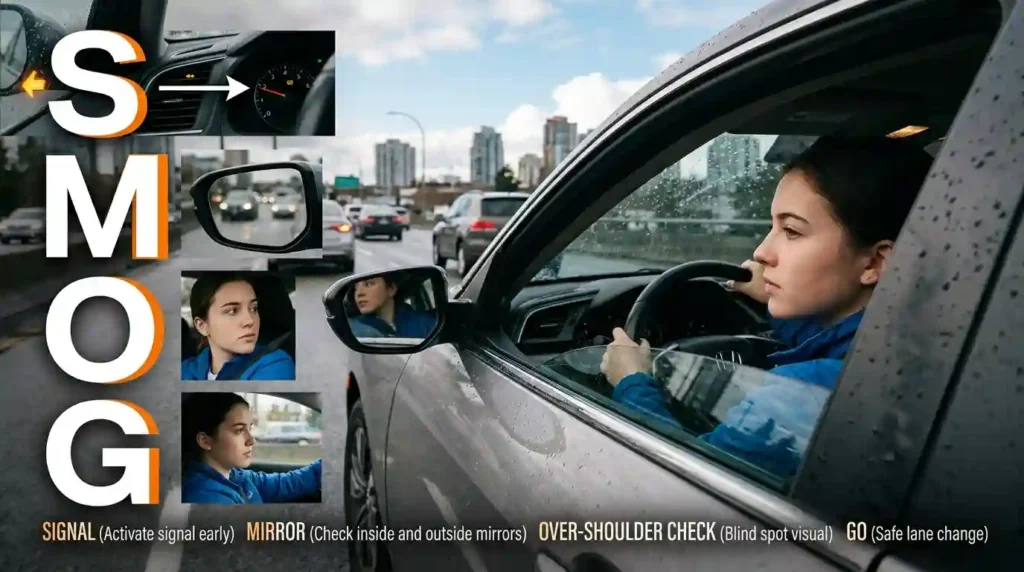
S.M.O.G. is an acronym that stands for Signal, Mirror, Over-the-shoulder. Signal means using your turn signal to let other drivers know your intentions. Mirror means checking your mirrors to confirm there’s no traffic approaching from the rear. Over-the-shoulder means glancing over your shoulder to make sure your blind spot is clear. Go means gradually changing lanes once you’ve confirmed it’s safe. While maintaining your speed so you don’t disrupt traffic already in that lane</cite>.
Breaking Down Each Step
| Letter | Step | What It Means |
| S | Signal | Turn on your indicator to alert nearby drivers |
| M | Mirror | Check rearview and side mirrors for approaching traffic |
| O | Over-the-shoulder | Physically turn your head to check the blind spot |
| G | Go | Move into the lane smoothly once it’s confirmed clear |
This table is worth memorizing, because each step exists specifically to close a different visibility gap.
Why the S.M.O.G. Technique Exists
Understanding what does S.M.O.G. mean in driving is only useful if you also understand why the sequence matters. Lane changes are riskier than most drivers assume.
<cite index=”53-1″>Roughly 539,000 two-vehicle lane change crashes occurred in the U.S. in a single analyzed year, according to National Highway Traffic Safety Administration crash data</cite>. Separately, <cite index=”50-1″>more than 840,000 blind spot–related accidents happen annually in the U.S., contributing to nearly 300 fatalities, with the majority involving lane changes or merging, especially at highway speeds</cite>.
Those numbers explain exactly why driving instructors lean so heavily on a memorable, repeatable checklist. A single skipped step — forgetting to signal, trusting mirrors alone, or rushing the head check — is often the difference between a safe lane change and a collision.
The Blind Spot Problem, Specifically
Mirrors don’t show everything. <cite index=”45-1″>Naturalistic driving research examining real lane-change events found that during the three seconds before a planned left-lane change, only 46 percent of drivers looked toward their left mirrors, 50 percent looked toward their left windows, and just 17 percent checked their center mirrors</cite> — highlighting how inconsistently drivers actually perform the visual checks that prevent crashes. This is exactly the gap the “O” in S.M.O.G. — the over-the-shoulder check — is designed to close, since mirrors alone consistently miss a vehicle sitting in the blind spot.
How to Use S.M.O.G. Step by Step
Here’s a practical walkthrough of the technique in action:
- Check your surroundings first. Before signaling, glance at traffic conditions to identify a safe gap in the target lane.
- Signal early. <cite index=”36-1″>Activate your turn signal at least three to five seconds before starting the lane change, giving other drivers and pedestrians time to anticipate your move and react accordingly</cite>.
- Check your mirrors. Look at your rearview mirror and the side mirror on the side you’re moving toward.
- Do the over-the-shoulder check. Turn your head — not just your eyes — to look directly into the blind spot on that side.
- Go smoothly. Once you’ve confirmed the lane is clear, move over at a steady pace without slowing down traffic already in that lane.
Practicing this sequence until it becomes automatic is exactly what driving instructors mean when they explain what does S.M.O.G. mean in driving to new students — it’s not just trivia, it’s muscle memory for a genuinely dangerous maneuver.
Common Mistakes Drivers Make With Lane Changes
Even drivers who know what does S.M.O.G. mean in driving sometimes skip steps under pressure. Watch for these habits:
- Skipping the signal or turning it on at the same moment as the lane change, giving other drivers no warning
- Checking mirrors only, without ever turning to look at the actual blind spot
- Rushing the “Go” step, cutting too sharply into the new lane
- Changing lanes too close to an intersection or exit, leaving little margin for error
- Multiple lane changes at once, instead of moving one lane at a time
Each of these mistakes maps directly onto the crash data — inconsistent mirror use, skipped signals, and rushed blind-spot checks show up again and again in lane-change crash research.
What Does S.M.O.G. Mean in Driving? with example
To see how this plays out in real driving, picture a common highway scenario. You’re driving in the right lane and need to move left to prepare for an upcoming exit that’s coming up on the left side.
- Signal: You activate your left turn signal a few seconds before you plan to move, giving the driver behind you time to notice.
- Mirror: You check your rearview mirror, then your left side mirror, and see a car a few car-lengths back but no immediate conflict.
- Over-the-shoulder: You turn your head briefly to the left and spot a motorcycle riding in your mirror’s blind spot — a vehicle your mirrors alone never showed you.
- Go: You wait a few seconds for the motorcycle to pass, then complete the lane change once the space is genuinely clear.
That fourth step — catching a vehicle the mirrors missed — is exactly why the technique exists in the first place, and it’s a scenario driving instructors describe constantly when explaining what does S.M.O.G. mean in driving to new students.
S.M.O.G. remains one of the most widely taught versions in North American driver’s ed specifically because of its simplicity — four steps, four letters, and a direct link to the exact motion a driver is about to perform.
Who Teaches S.M.O.G. and Why It Sticks
Driving schools favor S.M.O.G. because it’s concrete and testable — an instructor can watch a student perform each letter in real time. It’s commonly introduced early in driver’s education courses, reinforced during behind-the-wheel lessons, and frequently referenced again during license road tests when examiners are specifically looking for a visible head turn before a lane change.
This is also why the phrase shows up so often in searches asking what does S.M.O.G. mean in driving — it’s not obscure jargon confined to a textbook. It’s a technique instructors expect students to actually demonstrate, not just recite.
Frequently Asked Questions
What does S.M.O.G. mean in driving?
S.M.O.G. stands for Signal, Mirror, Over-the-shoulder, and Go. It’s a four-step technique drivers use to change lanes safely.
No. While it’s a staple of driver’s education, experienced drivers benefit from the same habit. Skipping the over-the-shoulder step is a common cause of blind-spot collisions regardless of how long someone has been driving.
How is S.M.O.G. different from just checking mirrors?
Mirrors don’t cover the entire blind spot, which is exactly the area beside and slightly behind your vehicle that neither the rearview nor side mirrors fully capture.
What Does S.M.O.G. Mean in Driving? Apply to merging onto highways too?
Yes. The same signal, mirror, blind-spot, and go sequence applies whether you’re changing lanes on a local road or merging onto a highway.
Do blind spot monitoring systems make S.M.O.G. unnecessary?
No. While blind spot monitoring technology has been shown to reduce lane-change crash rates, it’s a backup, not a replacement.
Is S.M.O.G. used outside the United States?
The exact acronym is most common in North American driver’s education, though similar step-by-step lane-change methods, like MSM in the UK.
Will I be tested on S.M.O.G. during my driving test?
Most road test examiners won’t ask you to explain the acronym directly, but they will watch for the behaviors it represents — specifically, whether you signal, check mirrors, and perform a visible head turn before changing lanes.
Love To Read More 140+ Things to Do on a Computer When Bored: Creative & Productive Ideas
Conclusion
So, what does S.M.O.G. mean in driving? It’s shorthand for Signal, Mirror, Over-the-shoulder, and Go — a simple sequence that closes the exact visibility gaps responsible for hundreds of thousands of lane-change crashes every year. It’s not a flashy piece of driving trivia; it’s a habit backed by real crash data showing how often drivers skip mirror checks or blind-spot glances in the seconds before changing lanes. Whether you’re studying for a driving test or just want to sharpen habits you picked up years ago, running through Signal, Mirror, Over-the-shoulder, Go every time you change lanes is one of the simplest ways to make that maneuver measurably safer.