When someone asks b.t.a. meaning, they’re usually trying to decode a message that suddenly introduced a second thought, contradiction, or alternative idea. It often appears in sentences where the speaker is reconsidering what they just said or adding another angle to their opinion.
The expression BTA is one of those small internet shortcuts that quietly changes the tone of a sentence. It doesn’t shout, it doesn’t announce itself, and yet it completely shifts meaning when used correctly. That’s exactly why it shows up so often in casual texting, social media replies, and even quick decision-making conversations.
This article breaks down everything in a simple, real-world way—no confusing grammar jargon, no overcomplicated explanations. You’ll learn what it actually means, how people use it in real chats, where it fits in sentences, and the mistakes that can change the meaning completely.
By the end, you’ll not only understand the phrase but also recognize it instantly when it shows up in everyday conversations.
What Is B.t.a. meaning Explained in Simple Terms
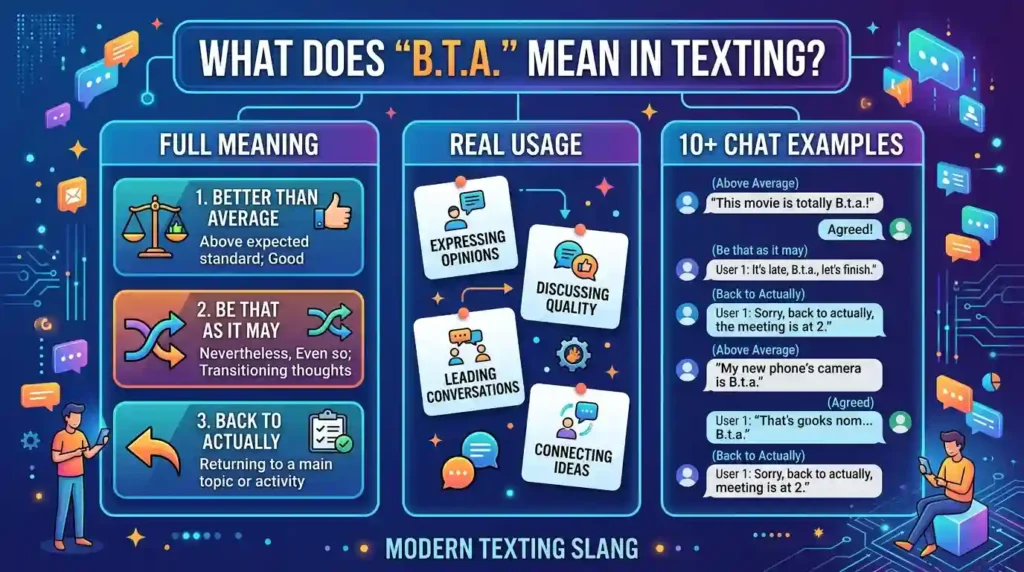
At its core, BTA stands for “But Then Again.”
It is used when someone introduces a second thought, contradiction, or alternative viewpoint after making a statement. It works like a mental “pause and rethink” moment inside a sentence.
For example:
- “I don’t really like going out… BTA, it depends on who’s inviting.”
Here, the speaker first makes a general statement and then slightly adjusts or softens it.
This is why the phrase is so common in texting—it mirrors how people actually think. We rarely stick to one fixed opinion. Instead, we adjust our thoughts mid-sentence, and BTA helps express that shift naturally.
When people search for what does b t a mean, they’re usually trying to understand this shift in tone. It’s not just an abbreviation; it’s a conversational tool that signals reconsideration.
In written form, it often appears in lowercase, uppercase, or mixed:
- BTA
- bta
- B.T.A.
But regardless of styling, the meaning stays the same.
The expression is especially popular in casual chats because it saves time while keeping the message natural and expressive.
The phrase b.t.a. meaning is often misunderstood as something technical or formal, but it is purely conversational. It is not used in academic writing, professional emails, or formal documentation.
Instead, it belongs in:
- Text messages
- Social media comments
- Casual online discussions
- Informal emails (rarely)
Understanding this distinction helps avoid confusion when switching between formal and informal communication.
How BTA Is Used in Text Conversations (Real Usage Patterns)
To fully understand what does b t a mean, you need to see how it behaves inside real sentences. It doesn’t function as a standalone word—it always connects two thoughts.
1. Adding a second opinion
“I think this phone is too expensive… BTA it does have great battery life.”
Here, the speaker first gives a negative opinion, then balances it with a positive one.
2. Changing direction mid-thought
“I was going to skip the movie… BTA, I heard it’s actually really good.”
This shows hesitation or reconsideration.
3. Softening a strong statement
“That idea makes no sense… BTA, maybe I’m missing something.”
It reduces harshness and adds openness.
4. Comparing two ideas
“We could go Saturday… BTA, Sunday might be better for everyone.”
This shows flexibility in decision-making.
The key function of b.t.a. meaning in texting is flexibility. It allows people to stay non-committal while still expressing an opinion.
Unlike rigid phrases, it leaves space for doubt, correction, or additional thinking.
That’s why it fits so naturally into texting culture—because online conversations move fast, and people often think while typing.
When someone asks what does b t a mean, they’re really trying to understand how this shift in tone works in real communication, not just its dictionary definition.
Why People Use BTA Instead of Writing Full Sentences
The rise of abbreviations like BTA is directly connected to how people communicate online today. Speed and expression matter more than grammatical completeness.
Here’s why it’s used so frequently:
1. Faster communication
Typing “but then again” repeatedly in conversations slows things down. BTA shortens it without losing meaning.
2. Natural thinking style
People rarely think in fixed sentences. Thoughts change mid-flow, and BTA reflects that change naturally.
3. Tone control
Instead of sounding too strict or final, BTA softens opinions.
For example:
- Without BTA: “I don’t like this.”
- With BTA: “I don’t like this… BTA it might work for others.”
4. Social media friendliness
On platforms like Instagram, Snapchat, or WhatsApp, short expressions keep conversations light and fast.
In short, the phrase b.t.a. meaning is less about grammar and more about communication style. It reflects how people actually think and talk in digital spaces.
Understanding this helps explain why what does b t a mean is such a common search query—it appears in everyday conversations where tone matters more than structure.
Tone and Context: When BTA Changes the Entire Meaning
One of the most interesting things about BTA is that it can completely shift the emotional tone of a message.
Neutral to flexible
“I don’t like spicy food… BTA I can eat mild curry.”
This turns a firm opinion into a flexible one.
Negative to balanced
“He’s not very reliable… BTA, he helped me last week.”
This adds fairness to the statement.
Decision hesitation
“I’ll stay home tonight… BTA I might go out later.”
This introduces uncertainty.
Without BTA, sentences feel final. With it, they feel open-ended.
That’s why understanding what does b t a mean is important for reading between the lines in chats. It’s not just the words—it’s the shift in attitude that matters.
The b t a definition is closely tied to emotional nuance, not just literal translation. It signals that the speaker is still thinking.
Real-World Chat Examples of BTA in Action
Here are practical examples showing how BTA appears in real conversations:
Example 1
A: “Are you coming tonight?”
B: “I’m not sure… BTA I might show up late.”
Example 2
A: “Do you like this design?”
B: “It’s okay… BTA, it could be improved.”
Example 3
A: “Should I buy this phone?”
B: “It’s expensive… BTA it’s worth it for the camera.”
Example 4
A: “Are you upset?”
B: “Not really… BTA I was a bit annoyed earlier.”
Example 5
A: “Do you want pizza?”
B: “No, I’m not hungry… BTA I could eat a slice.”
These examples show how flexible the phrase is. It doesn’t follow strict grammar rules; instead, it adapts to natural speech flow.
If someone still wonders what does b t a mean, these examples make it clear—it’s about adding a second layer of thought.
Common Mistakes and Misunderstandings About BTA
Many people misread or misuse BTA because it looks like an acronym with multiple meanings.
Mistake 1: Thinking it is formal
BTA is not professional language. Using it in business emails can look unprofessional.
Mistake 2: Treating it as a fixed abbreviation
Unlike technical acronyms, BTA doesn’t have multiple structured definitions. Its meaning stays contextual.
Mistake 3: Using it without contrast
BTA only works when there is a shift in thought. Using it without contrast makes sentences confusing.
Mistake 4: Overusing it
Too much use can make writing feel uncertain or indecisive.
Understanding the correct b.t.a. meaning helps avoid these issues and ensures clear communication.
Comparison: BTA vs Similar Chat Expressions
To fully understand what does b t a mean, it helps to compare it with similar expressions.
BTA vs “But”
- “But” is direct and simple.
- BTA feels more reflective and conversational.
BTA vs “On the other hand”
- “On the other hand” is longer and more analytical.
- BTA is quick and informal.
This comparison shows that BTA is not just a shortcut—it’s a tone-setting tool.
The b.t.a. meaning sits in a unique space between casual speech and reflective thinking, making it ideal for texting culture.
Conclusion
BTA may look like just three simple letters, but in texting, it plays a surprisingly important role. It captures hesitation, balance, and changing opinions in a way that feels natural and quick.
Instead of forcing people to choose one fixed thought, it allows conversations to stay flexible and human-like. That’s why it appears so often in chats, comments, and informal messages.
Now when you see someone use it, you won’t be confused—you’ll understand that they’re simply adding another layer to their thought.
And if someone asks you b.t.a. meaning, you can confidently explain it as more than an abbreviation—it’s a reflection of how people actually think while talking.
FAQ: BTA Meaning in Texting
1. What does b.t.a. meaning in texting?
BTA stands for “But Then Again.” It is used to introduce a second thought or alternative opinion in casual conversations, especially in texting and social media chats.
2. Is BTA formal or informal language?
BTA is strictly informal. It is used in casual conversations and should not be used in professional or academic writing because it can sound too relaxed or unclear.
3. Can BTA be used in emails?
It is generally not recommended to use BTA in formal emails. Instead, write out “but then again” for clarity and professionalism in workplace communication.
4. Why do people use BTA instead of writing the full phrase?
People use BTA because it is faster to type and reflects natural thinking patterns. It helps express hesitation or a change in opinion without slowing down the conversation.
5. Is BTA the same as “but”?
Not exactly. “But” is a direct contrast word, while BTA introduces a softer, more reflective shift in opinion or thought.
6. Does BTA have more than one meaning?
In texting, it almost always means “But Then Again.” Context is important, but alternative meanings are rare in casual chat usage.
7. Why is understanding BTA important in chats?
Knowing what does b t a mean helps you correctly interpret tone, hesitation, or changes in opinion in messages, preventing misunderstandings in conversations.