That confusion is exactly why so many people search for what does mk mean in text. On the surface, it looks like a simple abbreviation, but in real conversations it can carry tone, attitude, and sometimes even emotional hints depending on how it’s used. What makes it trickier is that it doesn’t always behave the same way across different platforms like Snapchat, WhatsApp, or Instagram.
You’re scrolling through a chat, and someone replies “mk” instead of “okay.” It looks harmless, but suddenly you’re wondering if they’re being rude, lazy, or just typing fast. A few messages later, another person uses it again, and now it feels like there’s a hidden meaning everyone else understands except you.
The interesting part is that people often assume it’s just a shortened “okay,” but that’s only half the story. Depending on context, “mk” can sound casual, dismissive, or even slightly passive-aggressive. That’s why understanding mk meaning is more about reading the situation than memorizing a dictionary definition.
What is MK in Text Messages?
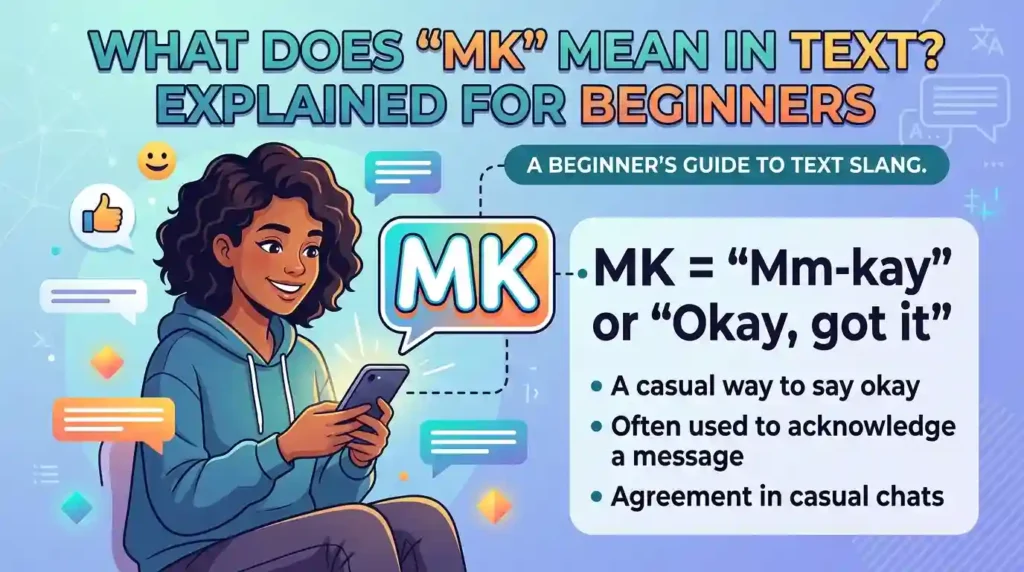
At its simplest, “mk” is a shortened version of “mmkay” or “okay.” It is used in casual conversations when people want to acknowledge something quickly without typing a full response.
But here’s where it gets interesting. The phrase what does mk mean in text often comes up because users notice that the tone changes depending on how it’s used. Sometimes it feels friendly, other times it feels short or uninterested.
The basic mk meaning usually falls into three categories:
- A casual “okay”
- A quick acknowledgment
- A soft or neutral agreement
However, tone plays a huge role. For example:
- “mk” alone can feel slightly cold in serious conversations
- “mk :)” feels more friendly and relaxed
- “mk lol” adds humor and reduces seriousness
Unlike formal abbreviations, “mk” doesn’t have a strict rulebook. It evolves based on how people use it in real-time chats. That flexibility is what makes it both useful and confusing at the same time.
In short, “mk” is a digital shortcut that replaces longer replies, but its emotional tone depends entirely on context.
MK Meaning in Casual Conversations
In everyday texting between friends, “mk” is usually used as a fast acknowledgment. It saves time and keeps the conversation moving without unnecessary typing.
When people search what does mk mean in text, they are often seeing it in casual situations like:
- Planning meetups
- Responding to short instructions
- Agreeing with something quickly
In these cases, mk meaning is usually neutral. It simply means “I understand” or “I agree.”
For example:
- “Be there at 6.”
→ “mk” - “Don’t forget the assignment.”
→ “mk”
It’s short, efficient, and widely accepted in informal chats.
However, tone can still matter. If someone is already upset or the conversation is serious, “mk” can feel like the person is brushing things off. That’s why interpretation is so important.
The key idea is this: “mk” is not emotional on its own. It becomes emotional based on context, timing, and the relationship between the people talking.
MK Meaning on Social Media Platforms
Social media platforms like Snapchat, Instagram, and WhatsApp have shaped how abbreviations like “mk” are used today.
On Snapchat, conversations are fast and temporary, so people often use “mk” to respond quickly without overthinking. Here, the meaning is usually light and casual.
On Instagram, it often appears in DMs or comment replies where users want to acknowledge something without engaging deeply. For example, replying “mk” to a long message can sometimes feel distant depending on tone.
On WhatsApp, which is used for both personal and semi-formal chats, “mk” can feel more sensitive. In group chats, it might be completely normal. In one-on-one conversations, it can sometimes be interpreted differently depending on mood.
This is why what does mk mean in text becomes a frequent search query. The same abbreviation behaves differently across platforms because communication styles differ.
Another important factor is speed. Social media encourages short responses, and “mk” fits perfectly into that pattern. But because it’s so short, it sometimes lacks emotional clarity.
So while mk meaning stays generally the same at its core, the perception changes depending on the platform it’s used in.
Emotional Tone Behind MK in Text
One of the most misunderstood parts of “mk” is its emotional tone. Unlike longer replies, it doesn’t clearly express mood, which leads to confusion.
When someone types “mk,” it can feel:
- Neutral (simple acknowledgment)
- Slightly distant (short response)
- Calm and casual (relaxed agreement)
That’s why people often ask what does mk mean in text when they feel unsure about the tone behind a message.
For example:
- “I’m not feeling well.”
→ “mk”
In this case, it may feel cold if the sender expected empathy.
But:
- “We’re meeting at 5.”
→ “mk”
Here, it feels completely normal.
The emotional interpretation depends on:
- Relationship between sender and receiver
- Previous messages in the conversation
- Current emotional context
This is why the meaning is not fixed. It behaves more like a tone indicator than a definition.
In short, “mk” is a blank emotional canvas that gets colored by the situation around it.
Why People Use MK Instead of Okay
People don’t randomly switch from “okay” to “mk” without reason. There are practical motivations behind it.
First, speed matters. Typing “mk” is faster than typing “okay,” especially in fast conversations.
Second, style plays a role. Many users prefer shorter, more modern-looking responses in casual chats.
Third, repetition avoidance. In long conversations, repeatedly saying “okay” can feel boring, so “mk” adds variation.
This is where what does mk mean in text becomes relevant again, because users notice the shift in communication style and want to understand it.
In terms of mk meaning, it is essentially a shortcut that reflects digital communication habits rather than a linguistic rule.
Another reason is peer influence. If friends use “mk,” others naturally adopt it to match the group’s texting style.
So “mk” is not just a word—it’s a behavior pattern shaped by online communication culture.
Real-World Examples of MK in text
To fully understand how “mk” works, it helps to see it in actual conversations.
Example 1: Simple agreement
A: “Send me the file when you’re free.”
B: “mk”
Example 2: Casual planning
A: “Let’s meet after school.”
B: “mk sounds good”
Example 3: Slightly distant tone
A: “I think we should take a break.”
B: “mk”
This last example shows why people search for what does mk mean in text, because tone becomes unclear in emotional conversations.
Example 4: Friendly casual chat
A: “I’ll call you later”
B: “mk lol”
In these examples, mk meaning of ” mk ” shifts depending on tone, context, and emotional background. It is flexible, not fixed.
Common Mistakes and Misconceptions
A major mistake people make is assuming “mk” always means something negative. That is not true.
Another misconception is that it is rude by default. In reality, tone depends on context, not the abbreviation itself.
Some users also think “mk” is formal slang or has a hidden meaning. It doesn’t.
When people search what does mk mean in text, they often expect a single definition, but the reality is more flexible.
Another mistake is overanalyzing it. Not every short reply carries emotional weight. Sometimes it is just a fast response.
Understanding mk meaning requires balancing interpretation instead of jumping to conclusions.
Comparison: MK vs OK vs K
To understand “mk” better, comparing it with similar responses helps:
- OK → Neutral and standard
- K → Very short, sometimes feels cold
- MK → Casual, slightly softer than “K”
This comparison shows why mk meaning sits in the middle of casual texting responses.
Unlike “OK,” it feels more modern. Unlike “K,” it feels slightly more relaxed.
That’s why people searching what does mk mean in text often find it confusing—it sits between emotional tones rather than belonging to one category.
FAQ
1. What does MK mean in text?
MK is a casual abbreviation for “mmkay” or “okay.” It is used to acknowledge messages quickly without typing full responses, especially in informal conversations between friends or social media chats.
2. Is MK rude in text?
Not necessarily. MK is not rude by default. However, in emotional or serious conversations, it can feel short or distant depending on tone and context, so interpretation matters.
3. Why do people use MK instead of OK?
People use MK for speed, style, and casual expression. It is shorter than “okay” and often feels more relaxed or modern in informal digital communication.
4. Does MK have different meanings on social media?
Yes, depending on the platform and conversation style, MK can feel more casual, neutral, or slightly distant. However, the core meaning remains an acknowledgment or agreement.
5. How do I know what MK means in a message?
Look at the context, tone of the conversation, and relationship with the sender. These factors help determine whether MK feels neutral, casual, or emotionally detached.
6. Is MK the same as K?
Not exactly. MK is usually softer and more casual, while “K” can sometimes feel more abrupt or cold in comparison.
7. Can MK be used in formal conversations?
It is best avoided in formal or professional communication. MK is informal slang and is more suited for casual chats.
Conclusion
“MK” might look like a simple abbreviation, but its meaning depends heavily on context, tone, and conversation style. In most cases, it simply replaces “okay,” but its emotional interpretation can vary from neutral to slightly distant depending on how it is used.
Understanding what does mk mean in text is less about memorizing definitions and more about reading conversation patterns. Once you understand that, interpreting messages becomes much easier and more natural.
At its core, mk meaning reflects how digital communication prioritizes speed and simplicity over long explanations. And that’s exactly why it appears so often in modern texting—it gets the job done with minimal effort