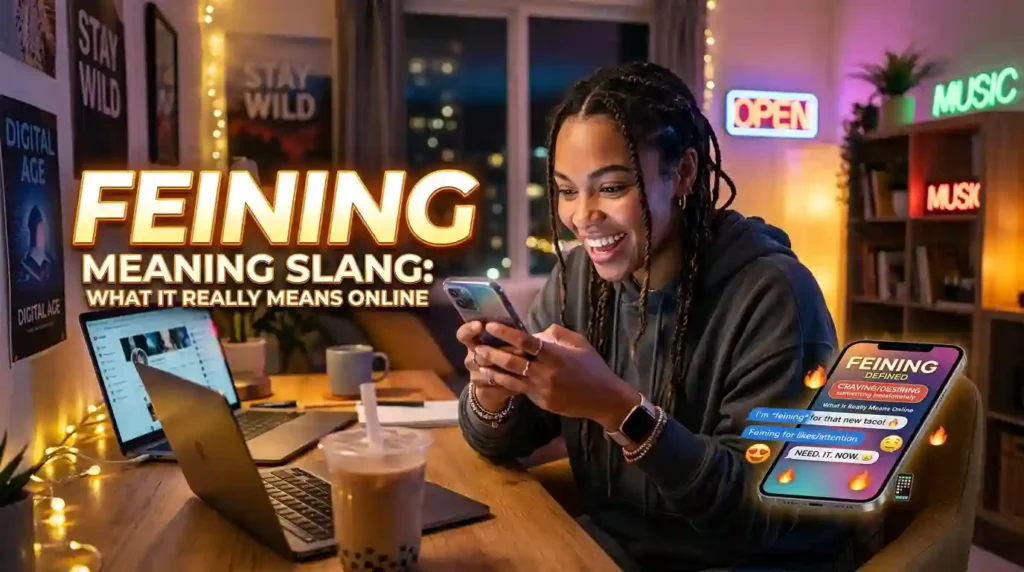
The truth is that understanding the feining meaning slang requires looking at how language evolves online. While the term has roots that go back decades in spoken English and hip-hop culture, social media has pushed it into mainstream internet vocabulary.
Today, the word is commonly used to describe someone who strongly desires, craves, or is obsessed with something. Depending on the context, it can be playful, exaggerated, or occasionally critical.
This guide explains where the slang came from, what it means, how people use it online, real-life examples, common misconceptions, and why it has become one of the internet’s most recognizable expressions.
What Does Feining Mean in Slang?
In modern internet slang, “feining” generally means:
Having an intense desire, craving, obsession, or eagerness for something.
Someone who is feining is usually portrayed as wanting something so badly that it becomes noticeable to others.
Examples:
- “He’s feining for concert tickets.”
- “I’m feining for some coffee right now.”
- “They were feining to see the season finale.”
In casual online conversations, the word often exaggerates the level of desire for humorous effect.
For example:
- “I’m feining for pizza” simply means “I really want pizza.”
- “He’s feining for attention” suggests someone is constantly seeking attention.
The expression is often stronger than saying “wanting” but less serious than describing an actual addiction.
Is It “Feining” or “Feening”?
One reason people search for the term is because of spelling confusion.
You’ll commonly see:
| Spelling | Usage |
| Feining | Common online spelling |
| Feening | Widely accepted slang spelling |
| Fiending | Traditional dictionary spelling |
Historically, the slang comes from the word “fiend” or “fiending.”
The original expression “fiending for something” meant craving something intensely.
Over time, pronunciation changes and internet culture led to alternate spellings such as:
- feening
- feining
- fein
As a result, many people searching for the feining meaning slang are actually looking for the same concept as “fiending.”
The Origin of the Word
The roots of the term can be traced to African American Vernacular English (AAVE), where “fiending” became a common way to describe someone craving something intensely.
Historically, the word “fiend” referred to:
- An evil spirit
- A person obsessed with something
- Someone addicted to a substance
During the late 20th century, the term evolved in spoken English and urban culture to mean:
- Desperately wanting something
- Craving a particular experience
- Being overly eager
Hip-hop music helped popularize the expression throughout the 1990s and 2000s.
As social media platforms emerged, younger users began shortening and respelling words to match how they sounded in conversation. That’s one reason forms like “fein” and “feining” became common online.
Why Is the Word So Popular on TikTok?
TikTok has become one of the biggest drivers of slang adoption worldwide.
Research from various social media analytics firms consistently shows that Gen Z users frequently introduce, remix, and spread language trends through short-form video content.
Several factors helped this slang gain popularity:
1. Short and Easy to Use
The word is quick to type and easy to understand in context.
Example:
- “Everyone feining for that update.”
The meaning is instantly recognizable.
2. Works in Many Situations
Users can apply it to:
- Food
- Music
- Sports
- Relationships
- Video games
- Celebrity culture
This flexibility makes it highly shareable.
3. Exaggeration Creates Humor
Internet culture often rewards dramatic language.
Instead of saying:
- “I want coffee.”
People say:
- “I’m feining for coffee.”
The exaggeration makes the statement more entertaining.
Feining Meaning Slang Explained
Many users also search for feining meaning slang.
In online conversations, “fein” often functions as a shortened form of:
- fiend
- fiending
- feening
Examples include:
- “You’re a fein for that game.”
- “He’s a sneaker fein.”
- “I’m a coffee fein.”
In these examples, the word describes someone who is highly enthusiastic or obsessed with something.
The exact meaning depends on context.
Positive Usage
- Passionate fan
- Dedicated supporter
- Enthusiast
Example:
- “She’s a book fein.”
Meaning:
- She loves reading books.
Negative Usage
- Excessively obsessed
- Desperate for something
Example:
- “Stop being a validation fein.”
Meaning:
- Stop constantly seeking approval.
Context determines whether the term sounds playful or critical.
Real-World Examples of Usage
Here are realistic examples you might see online.
Entertainment
“Marvel fans are feining for the next trailer release.”
Meaning:
Fans are eagerly waiting for the trailer.
Gaming
“Players were feining for early access.”
Meaning:
Gamers strongly wanted access before launch.
Sports
“Everyone was feining for playoff tickets.”
Meaning:
Demand for tickets was extremely high.
Food
“I’ve been feining for tacos all day.”
Meaning:
I have been craving tacos.
Social Media
“She posts every hour because she’s feining for engagement.”
Meaning:
She wants likes and comments constantly.
Differences Between Wanting, Craving, and Feining
The terms are related but not identical.
| Expression | Intensity Level | Example |
| Wanting | Low | I want pizza |
| Craving | Medium | I’m craving pizza |
| Feining | High | I’m feining for pizza |
The slang version often implies:
- Strong anticipation
- Obsession
- Excitement
- Humor
In most cases, people use it casually rather than literally.
Common Contexts Where You’ll See It
Social Media Comments
Examples:
- “They’re feining for attention.”
- “Everyone’s feining over the announcement.”
Group Chats
Examples:
- “I’m feining for the weekend.”
- “We’re all feining for payday.”
Gaming Communities
Examples:
- “The community is feining for updates.”
- “Players are feining for new content.”
Music Fandoms
Examples:
- “Fans have been feining for new music.”
Sports Discussions
Examples:
- “People were feining for championship tickets.”
Is the Word Offensive?
Generally, no.
However, context matters.
Historically, the term’s roots connect to words associated with addiction and intense craving.
Today, most users employ it casually and humorously.
Examples generally considered harmless:
- “I’m feining for coffee.”
- “We’re feining for vacation.”
Examples that may sound critical:
- “He’s feining for attention.”
- “She’s feining for clout.”
In those cases, the speaker may be mocking someone’s behavior.
Common Misunderstandings
Myth 1: It Means Addiction
Not necessarily.
Most online uses simply mean:
- Wanting
- Craving
- Being excited about something
Myth 2: It’s a Brand-New Word
The expression has existed in spoken English for decades.
Social media simply revived and expanded its popularity.
Myth 3: Only Teenagers Use It
While Gen Z helped popularize it, adults increasingly use the term online as well.
Myth 4: It Has Only Negative Meaning
The term can be:
- Positive
- Neutral
- Negative
Depending entirely on context.
How to Use the Word Correctly
Here are practical examples.
Correct
- “I’m feining for the next episode.”
- “Fans are feining for the release.”
- “She’s feining for concert tickets.”
Less Natural
- “I was feining yesterday at 2 PM for mathematical calculations.”
The slang works best in casual conversations involving excitement, desire, anticipation, or enthusiasm.
Related Slang Terms
Many internet users encounter these words alongside this expression.
| Slang | Meaning |
| Cooked | In trouble or exhausted |
| Delulu | Delusional |
| Mid | Average quality |
| Rizz | Charisma |
| Cap | Lie |
| Bet | Okay or agreed |
| Bussin | Extremely good |
| GOAT | Greatest of all time |
| NPC | Acting robotic or predictable |
| Simp | Excessively devoted admirer |
These terms often appear together in TikTok, Twitch, Discord, Instagram, and gaming communities.
Love to Read More 150+ Things to Do When Bored – Exciting Activities to Keep You Entertained
Why Understanding Internet Slang Matters
Language changes constantly.
According to linguistic research, digital platforms accelerate language evolution by allowing millions of users to share new expressions instantly.
Understanding modern slang helps:
- Improve communication
- Understand online culture
- Follow social media trends
- Interpret comments accurately
- Connect with younger audiences
For marketers, content creators, educators, and businesses, understanding these expressions can also improve audience engagement.
Frequently Asked Questions
What does feining mean slang?
It usually means craving, wanting, or eagerly anticipating something. The term often exaggerates desire for humorous or dramatic effect.
Is feining a real word?
Traditional dictionaries typically recognize “fiending” rather than “feining.” However, feining has become a common internet spelling.
What is the difference between feining and fiending?
The meanings are generally the same. The difference is mainly spelling and online usage.
Is feining positive or negative?
It can be either. Context determines whether it describes enthusiasm or excessive obsession.
Why do people say fein?
“Fein” is often used as a shortened version of fiend, fiending, or feening in online conversations.
Is the word popular on TikTok?
Yes. TikTok, Instagram Reels, and other short-form content platforms have contributed significantly to its widespread use.
Can adults use the word?
Absolutely. While younger users popularized it online, people of all ages use internet slang.
Does it mean addiction?
Usually not. Most people use it casually to describe strong interest or excitement.
Conclusion
The feining meaning slang centers on the idea of strongly wanting, craving, anticipating, or obsessing over something. Although the term evolved from the older expression “fiending,” social media platforms transformed it into one of the most recognizable pieces of modern internet vocabulary.
Whether someone is talking about concert tickets, a new video game, coffee, vacation, or the latest trending show, the word helps express desire in a more dramatic and entertaining way. Understanding the related Fein meaning slang usage also makes it easier to interpret comments, memes, and conversations across TikTok, Instagram, Discord, and other online communities.