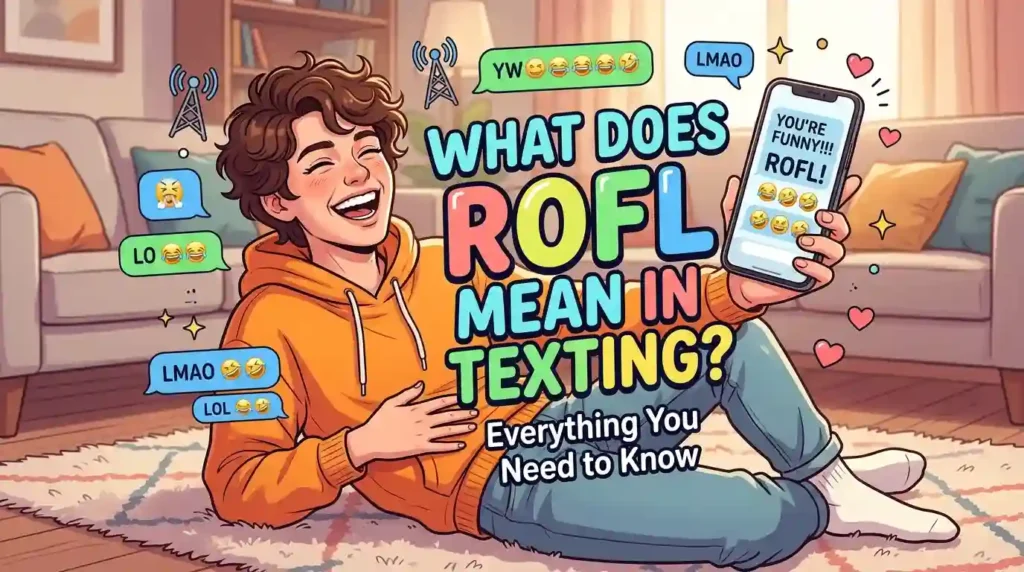
This guide breaks down exactly what does ROFL mean in texting, how it compares to LOL and LMAO, and how to use it naturally without sounding out of touch. We’ll also cover real usage data, common mistakes, and answers to the questions people ask most.
If you’ve ever sent a funny meme to a friend and gotten back a single reply — “ROFL” — you already have a rough idea of what it means. But if you want the full picture, including where the term came from and how to use it correctly, you’re in the right place.
What Does ROFL Mean in Texting?
ROFL stands for “Rolling On the Floor Laughing.” It’s an internet acronym used to show that something is extremely funny — funny enough to make you laugh uncontrollably, as if you’d physically fallen to the floor from laughing so hard.
The ROFL meaning hasn’t changed much since it first appeared online. It’s always been about exaggerated, intense laughter — a step up from a casual “haha” and typically stronger than LOL.
Quick Definition Table
| Term | Full Form | Laughter Intensity |
| LOL | Laugh Out Loud | Mild to moderate |
| ROFL | Rolling On the Floor Laughing | Strong, exaggerated |
| LMAO | Laughing My A** Off | Strong, more casual/crude |
| ROFLMAO | Rolling On the Floor Laughing My A** Off | Very strong, combined |
Where Did ROFL Come From?
Understanding the rofl meaning is easier when you know its history. ROFL is one of the oldest acronyms in internet culture, predating text messaging as we know it today.
- Late 1980s to early 1990s: The term began circulating on Usenet, one of the earliest online discussion networks, where fast typists needed shorthand for emotional reactions.
- 1993: Etymology records show ROFL was already established as an online chat abbreviation for “rolling on the floor laughing.”
- Late 1990s to early 2000s: ROFL exploded in popularity on AOL Instant Messenger (AIM), IRC chat rooms, and early web forums, where character limits and typing speed made abbreviations essential.
- 2002: ROFL received one of its first widely cited Urban Dictionary entries, cementing its place in mainstream internet slang.
- Mid-2000s: The playful spinoff “ROFLCOPTER” emerged in gaming and meme communities, imagining someone laughing so hard they spin like helicopter blades.
Before emojis, GIFs, and reaction stickers existed, typed abbreviations like ROFL were the primary way people expressed emotion online. That’s a big part of why the term stuck around for over three decades — it filled a real communication gap.
So when someone asks, what does ROFL mean in texting, the short answer is: it’s a way of saying “that was hilarious” without typing out the whole sentence.
ROFL vs. LOL vs. LMAO: What’s the Difference?
People often use these three acronyms interchangeably, but there are subtle differences worth knowing.
LOL (Laugh Out Loud)
LOL is the most common and most diluted of the three. Because it gets used so often — even for things that aren’t actually funny — it has lost some of its impact. People sometimes use LOL just to soften a message or acknowledge something casually.
ROFL (Rolling On the Floor Laughing)
ROFL is more deliberate. Because it’s used less frequently than LOL, it tends to carry more weight. When someone texts you ROFL, they usually mean it — this is one of the clearest signals in the rofl meaning conversation: it’s reserved for things that are genuinely, not just mildly, funny.
LMAO (Laughing My A** Off)
LMAO conveys similar intensity to ROFL but carries a slightly more casual, sometimes crude tone because of the mild profanity built into the phrase. It’s common among peers but less appropriate in mixed or more formal casual settings.
In short: if LOL is a chuckle, ROFL is a belly laugh, and LMAO is a slightly edgier version of that same belly laugh.
How to Use ROFL in a Text (With Examples)
Knowing what does ROFL mean in texting is one thing — using it naturally is another. Here are some real-world examples:
- Friend: “My dog just tried to bark at his own reflection and fell off the couch.” You: “ROFL, I need to see this video.”
- Group chat: “Boss accidentally sent the meme instead of the sales report to the whole company.” Reply: “ROFL 😂 I would’ve died.”
- Casual caption: “That moment when autocorrect changes ‘duck’ to something else in front of your grandma. ROFL.”
Capitalization Matters
- ROFL (all caps) reads as more enthusiastic, especially paired with an exclamation point.
- rofl (lowercase) feels more subdued, almost like an aside, but still shows genuine amusement.
Common Variations
- ROFLMAO – combines ROFL and LMAO for maximum emphasis
- ROTFL – an older, less common ordering of the same letters
- ROFLCOPTER – a playful, meme-driven exaggeration
When You Should (and Shouldn’t) Use ROFL
Good Times to Use ROFL
- Texting friends or family about something genuinely funny
- Reacting to memes, videos, or social posts
- Casual group chats and comment sections
- Gaming chats and online communities
When to Avoid ROFL
- Professional emails or workplace Slack/Teams messages
- Formal documents or official communication
- Conversations with people you don’t know well, especially in a business context
- Sensitive topics where laughter could come across as inappropriate
Because ROFL is inherently informal, using it in a business email or a message to a client can come across as unprofessional. Save it for the relationships where casual tone is already the norm.
Is ROFL Still Used in 2026?
Yes — though its role has shifted. ROFL isn’t the dominant laughter acronym it was in the mid-2000s, when emojis and GIFs hadn’t yet taken over as the default way to react to something funny. Newer expressions like “I’m dead,” “I can’t,” or the 💀 emoji have taken some of the spotlight, especially among younger users.
That said, ROFL remains widely recognized across generations:
- Millennials and Gen X use it regularly in texts and social captions.
- Gamers and online communities kept ROFL alive through platforms like Discord, Reddit, and Twitch chat.
- Gen Z may reach for an emoji first, but still understands ROFL instantly when they see it.
Texting itself remains a massive part of daily communication, which keeps acronyms like ROFL relevant. In the United States alone, people send billions of text messages every single day, and heavy texters — particularly younger adults — routinely exchange dozens to over a hundred messages daily. That volume of casual, fast-paced conversation is exactly the environment where shorthand like ROFL thrives: it lets people convey a strong reaction without breaking their typing rhythm.
Why Acronyms Like ROFL Matter in Digital Communication
Text messages strip away tone of voice, facial expressions, and body language — all the non-verbal cues we normally rely on to interpret emotion. Acronyms like ROFL exist to fill that gap. They let you signal how funny something is, not just that it’s funny.
This is part of why abbreviations became such a core part of internet culture in the first place. Typing speed used to be a real constraint in early chat rooms, and short, expressive terms let people react quickly without slowing down the conversation. Even now, in an age of emojis and reaction GIFs, plain text acronyms remain useful because they’re universally understood, work on any device, and don’t require loading extra content.
ROFL Meaning: Quick Recap
| Question | Answer |
| What does ROFL mean in texting? | “Rolling On the Floor Laughing” — extreme amusement |
| Where did it come from? | Early internet chat rooms and forums, late 1980s–1990s |
| Is it stronger than LOL? | Yes, generally |
| Is it appropriate for work emails? | No, it’s informal |
| Is it still used today? | Yes, though less dominant than in the 2000s |
| Common variations | ROFLMAO, ROTFL, ROFLCOPTER |
Regional and Platform Differences
The rofl meaning stays consistent no matter where you encounter it, but the frequency of use can vary by platform and audience.
- Text messages and iMessage/WhatsApp threads: ROFL tends to appear in one-on-one or small group chats between people who already have a casual rapport.
- Social media comments: On platforms like Instagram or TikTok, ROFL often shows up alongside emojis like 😂 or 🤣 for added emphasis.
- Gaming chat and Discord: ROFL has stayed especially popular in gaming communities, where it’s often shortened further or combined with other slang.
- Forums and Reddit threads: Older internet communities still use ROFL regularly, partly out of nostalgia for early 2000s internet culture.
If you’re wondering what does ROFL mean in texting specifically versus in these other contexts, the good news is the definition doesn’t change — only the surrounding tone and formatting does.
Frequently Asked Questions
What does ROFL mean in texting?
ROFL means “Rolling On the Floor Laughing.” It’s used to show that something is extremely funny — much funnier than a simple “haha” would suggest.
Is ROFL the same as LOL?
Not exactly. Both express amusement, but ROFL usually signals stronger laughter than LOL, which gets used so often that it’s lost some of its original intensity.
What’s the difference between ROFL and LMAO?
They’re similar in intensity, but LMAO carries a slightly more casual or crude tone due to its wording. ROFL is considered a bit more universally acceptable in casual settings.
Can I use ROFL in a professional email?
It’s best to avoid it. ROFL is highly informal and better suited to texts, group chats, and social media than to workplace or formal communication.
Does ROFL always mean someone is actually laughing?
Not literally. Almost no one is actually rolling on the floor. It’s a figure of speech used to express strong amusement, similar to saying “I’m dying” or “I can’t breathe” when something is funny.
What does ROFLMAO mean?
ROFLMAO combines ROFL and LMAO into one term, meaning “Rolling On the Floor Laughing My A** Off.” It’s used for maximum emphasis when something is exceptionally funny.
Is ROFL outdated slang?
Not entirely. While emojis and newer expressions have taken some of its spotlight, ROFL is still widely recognized and used across age groups, particularly by millennials, Gen X, and online gaming communities.
How do you pronounce ROFL?
Most people spell it out letter by letter (R-O-F-L) rather than pronouncing it as a word, since it’s used almost exclusively in text-based communication.
Conclusion
So, what does ROFL mean in texting? At its core, it’s a simple way to express that something struck you as genuinely hilarious — more than a passing “lol,” less crude than “lmao.” Understanding the rofl meaning, along with when and where to use it, helps you communicate more naturally in casual texts, group chats, and social media.
While internet slang is always evolving, ROFL has stuck around for over three decades because it does exactly what it’s supposed to do: convey real, exaggerated laughter in just four letters. Use it with friends, skip it in professional settings, and you’ll always get the tone right.