In this guide, you’ll learn the complete ha ku na ma ta ta meaning, its origin, cultural significance, pronunciation, real-world usage, and why this phrase continues to resonate with millions of people worldwide.
Most people recognize the phrase from Disney’s The Lion King, where it became one of the most memorable songs in animated film history. However, the expression existed long before Disney introduced it to a global audience. It comes from the Swahili language and carries a simple yet powerful message about approaching life with fewer worries.
What Does Hakuna Matata Mean?
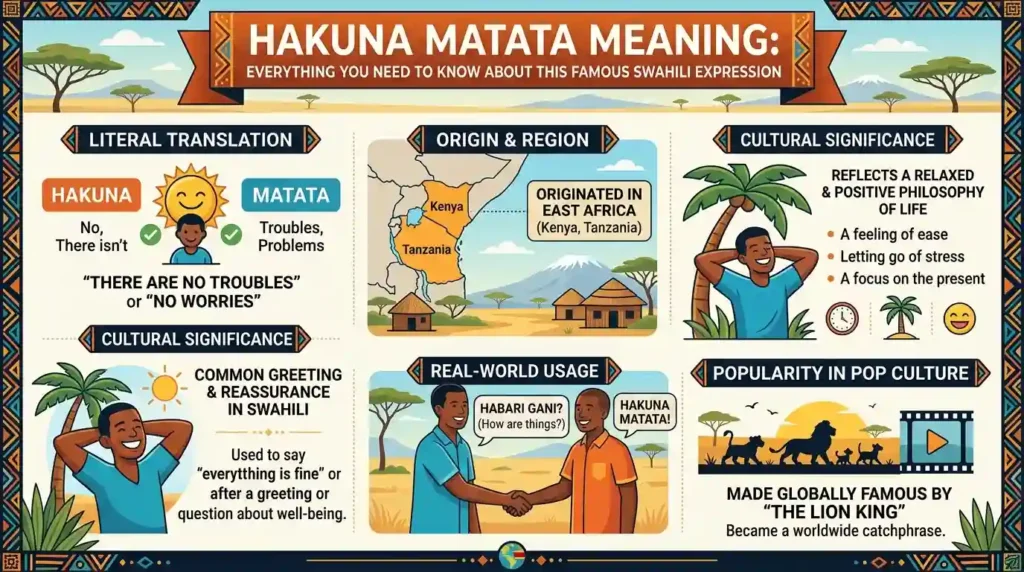
The ha ku na ma ta ta meaning is commonly translated into English as:
“No worries”
or
“There are no problems.”
The phrase comes from Swahili, a widely spoken language throughout East Africa.
Breaking it down:
| Swahili Word | Meaning |
| Hakuna | There is not / There are no |
| Matata | Problems, troubles, difficulties |
Combined, the phrase literally means:
“There are no problems.”
In everyday conversation, it conveys a relaxed attitude and encourages people not to stress over minor difficulties.
Read More 100+ What Are Things to Do When You’re Bored: Fun Activities to Keep You Engaged
Quick Answer
If someone asks, “What does Hakuna Matata mean?”, the simplest answer is:
It means “no worries,” “don’t worry,” or “everything is fine.”
The Origin of Hakuna Matata
To fully understand the ha ku na ma ta ta meaning, it’s important to look at its linguistic roots.
Hakuna Matata originates from the Swahili language, known locally as Kiswahili.
Swahili is one of Africa’s most widely spoken languages and serves as an official language in several countries, including:
- Tanzania
- Kenya
- Uganda
- Democratic Republic of the Congo
- Rwanda
- Burundi
According to international language estimates, Swahili is spoken by more than 100 million people across East and Central Africa, making it one of the most influential languages on the continent.
The phrase has been used in everyday speech for generations as a way of reassuring others that a situation is under control.
For native speakers, it is a common expression rather than a philosophical slogan.
How to Pronounce Hakuna Matata
Many English speakers pronounce it incorrectly.
The standard pronunciation is:
Ha-koo-nah Ma-tah-tah
Phonetic pronunciation:
/haˈkuːna maˈtata/
Tips:
- Every vowel is pronounced clearly.
- The “u” sounds like “oo.”
- The stress is generally even across the phrase.
Example:
“Hakuna Matata, everything will work out.”
Why Did Hakuna Matata Become Famous Worldwide?
Although the phrase was already common in East Africa, its worldwide popularity exploded in 1994 with Disney’s The Lion King.
The song “Hakuna Matata” introduced millions of viewers to the expression.
The song is performed by:
- Timon
- Pumbaa
- Simba
Within the movie, the phrase represents a carefree philosophy of life.
The lyrics describe living without unnecessary stress and focusing on the present moment.
As The Lion King became one of Disney’s most successful films, the phrase entered mainstream culture across the globe.
Today, many people know the expression even if they have never studied Swahili.
Hakuna Matata in The Lion King: Is the Translation Accurate?
A common question is whether Disney translated the phrase correctly.
The answer is:
Mostly yes.
The movie translates it as:
“No worries.”
While not a word-for-word translation, it effectively captures the intended meaning.
Native Swahili speakers generally agree that the phrase communicates freedom from concerns, troubles, or immediate problems.
However, some cultural experts note that the Disney interpretation emphasizes a carefree lifestyle more strongly than everyday Swahili usage.
In real life, people often use it simply as reassurance rather than as a life philosophy.
Cultural Significance of Hakuna Matata
Understanding the ha ku na ma ta ta meaning requires appreciating its cultural context.
In East Africa, the phrase reflects values such as:
- Optimism
- Patience
- Community support
- Emotional resilience
- Positive thinking
When someone faces a challenge, saying “Hakuna Matata” can be a way of expressing confidence that things will improve.
It often functions similarly to English expressions such as:
- Don’t worry.
- It’ll be okay.
- No problem.
- Everything’s under control.
The phrase promotes calmness without encouraging irresponsibility.
Common Situations Where People Use Hakuna Matata
Here are some everyday examples.
Example 1: A Friend Is Late
Person A:
“Sorry, I’m running 10 minutes late.”
Person B:
“Hakuna Matata.”
Meaning:
“No worries.”
Example 2: Minor Mistake at Work
Employee:
“I accidentally sent the wrong attachment.”
Manager:
“Hakuna Matata, just resend it.”
Meaning:
“It’s not a serious problem.”
Example 3: Travel Conversation
Tourist:
“Will the weather affect our trip?”
Guide:
“Hakuna Matata.”
Meaning:
“Everything should be fine.”
Hakuna Matata vs. Similar English Expressions
| Phrase | Meaning |
| Hakuna Matata | No worries |
| No Problem | Everything is okay |
| Don’t Worry | Stop feeling anxious |
| Take It Easy | Relax |
| It’s All Good | Nothing is wrong |
| No Big Deal | Not important |
While these expressions are similar, Hakuna Matata carries a distinct cultural identity linked to East Africa.
Is Hakuna Matata a Philosophy?
Many people treat Hakuna Matata as a philosophy of life.
The idea centers on:
- Reducing unnecessary stress
- Focusing on solutions
- Accepting what cannot be changed
- Maintaining optimism
However, it’s important to recognize that the original phrase is primarily an everyday expression rather than a formal philosophical system.
Disney’s interpretation helped transform it into a broader lifestyle concept.
Why People Love the Hakuna Matata Mindset
Modern life often involves:
- Work pressure
- Financial concerns
- Social expectations
- Information overload
As a result, people are naturally drawn to messages that encourage emotional balance.
Psychological research consistently shows that excessive worrying can negatively affect:
- Sleep quality
- Concentration
- Physical health
- Emotional well-being
While Hakuna Matata is not a solution to every problem, its reminder to avoid unnecessary stress resonates with many people.
Popular Uses of Hakuna Matata Today
The phrase appears in many areas of modern culture.
Travel and Tourism
Visitors to East Africa frequently encounter the expression on:
- Souvenirs
- T-shirts
- Hotels
- Tourist attractions
Social Media
People use it as:
- Captions
- Hashtags
- Motivational quotes
Examples:
- #HakunaMatata
- #NoWorries
- #PositiveVibes
Personal Development
The phrase is often used in discussions about:
- Mindfulness
- Stress management
- Positive thinking
- Emotional resilience
Interesting Facts About Hakuna Matata
Here are some lesser-known facts.
1. It Predates Disney by Many Generations
The expression existed long before The Lion King was created.
2. It Is Genuine Swahili
Unlike many movie catchphrases, Hakuna Matata is a real phrase used by native speakers.
3. It Is Recognized Worldwide
Few African expressions have achieved the same level of international recognition.
4. It Is Widely Understood in East Africa
Travelers in countries such as Kenya and Tanzania often hear it during daily interactions.
5. It Became a Global Cultural Symbol
The phrase now represents positivity and relaxation across many cultures.
Misconceptions About Hakuna Matata
Myth 1: It Means “Be Lazy”
False.
The phrase encourages calmness, not avoidance of responsibility.
Myth 2: Disney Invented It
False.
The expression existed for centuries before appearing in the film.
Myth 3: It Is Only Used in Kenya
False.
Swahili is spoken throughout multiple East African countries.
Myth 4: It Literally Means “No Worries”
Partially true.
The more direct translation is:
“There are no problems.
Why Hakuna Matata Remains Relevant Today
The popularity of the phrase continues because its message is universal.
People everywhere face:
- Stress
- Uncertainty
- Unexpected challenges
The simple reminder embedded in the ha ku na ma ta ta meaning helps people focus on what they can control rather than becoming overwhelmed by what they cannot.
Its simplicity is one of its greatest strengths.
Frequently Asked Questions (FAQ)
What is the exact ha ku na ma ta ta meaning?
The phrase means “there are no problems” and is commonly translated as “no worries.”
What language is Hakuna Matata from?
It comes from Swahili (Kiswahili), a major language spoken throughout East Africa.
Is Hakuna Matata a real phrase?
Yes. It is an authentic Swahili expression used in everyday conversation.
What does Hakuna Matata mean in English?
The closest English translations are:
- No worries
- Don’t worry
- No problem
- Everything is okay
Did Disney create Hakuna Matata?
No. Disney popularized the phrase internationally through The Lion King, but it existed long before the movie.
How do you pronounce Hakuna Matata?
It is commonly pronounced:
Ha-koo-nah Ma-tah-tah
Is Hakuna Matata used in Kenya?
Yes. It is widely understood and used in Kenya, Tanzania, and other East African countries.
Is Hakuna Matata a philosophy?
Originally, it was an everyday expression. However, many people now view it as a positive life mindset centered on reducing unnecessary worry.
Why is Hakuna Matata so famous?
Its global popularity comes largely from Disney’s The Lion King, one of the most successful animated films ever produced.
Can tourists use Hakuna Matata?
Yes. Locals generally understand and appreciate the phrase when used respectfully.
Conclusion
The ha ku na ma ta ta meaning” is no worries. Rooted in the Swahili language, the phrase literally means “there are no problems” and is commonly understood as “no worries.”
Its journey from everyday East African speech to global recognition demonstrates the power of language and culture to cross borders. Whether you know it from The Lion King, travel experiences, or social media, Hakuna Matata remains a timeless reminder to stay calm, focus on solutions, and avoid carrying unnecessary stress.
In a world filled with constant challenges, that simple message continues to resonate with people everywhere.
Love to Read More Things To Do When You’re Lazy